I mentioned the idea a while back that "you don't need that many knives."
I wanted to elaborate a bit...
The underlying theory of the everyday carry discipline, at least as far as I can manage to define it, is the belief that having a selection of tools on one's person is more beneficial than not. The ability to solve a variety of problems with the things in your pockets being the primary rationale. Naturally, it is impossible, or at least impractical, to carry tools to solve every problem that might arise. As such, tools which have a broad usefulness are often selected over those of a more specific purpose. For this reason, we often see knives, multi-tools, flashlights, pen and paper, and other such things of exceptionally broad utility. These items can be employed in a wide variety of ways to solve a wide variety of problems.
Importantly, an EDC kit also reflects the problems one believes may be encountered on any given day. It is in that individual thread that we see a variety of items of specific utility; a bicycle commuter may carry a patch kit, a photographer may have a lens pen, someone with severe allergies would carry an EpiPen, and so on and so forth.
That said, one of the most prevalent items found in everyday carry kits is a knife. Manifest in many different forms, ranging from keychain sized Swiss Army Knives to fixed blades with everything in between, knives play an incredibly important part in the EDC discipline.
Taking my data merely from the variety of pocket dump posts in various corners of the internet, I have come to the conclusion, as previously mentioned, that there are some people who carry too many knives absent a discernible purpose. They have taken "two is one and one is none" to an unrecognizable extreme. Multiple full-size folders in the same pair of pants as a Swiss Army Knife and a multi-tool. It's absurd!
Why? Diminishing return. A concept suggesting that with each additional unit the utility derived from that unit diminishes; additionally, the utility of all units decreases. Applied here, the utility of a knife is high. That single blade can be used for a great number of things to solve a great number of problems. A second blade is not as useful as the first. Now the two knives are both slightly less useful. One will be used, at most, 50% of the time. The same follows for all subsequent knives; they each become slightly more useless as additional knives are carried.
Furthermore, minimalism is paramount. Too many are infected by the disease of too much stuff. Yes, gear is cool but bulky pockets are not.
In most instances carrying more than one knife is simply unnecessary.
Showing posts with label Knives. Show all posts
Showing posts with label Knives. Show all posts

7/12/13
< 101 - You Don't Need That Many Knives
Chances are you've come across a photo of someone's alleged everyday carry and thought, "why does this guy (or gal) carry so many knives?"
It happens to me frequently. I'll come across someone who apparently carries three, four, or more knives on their person.
That simply strikes me as absurd. I can't fathom a reason to EDC more than two knives; it seems like an under-thought extension of "two is one, one is none."
The EDC discipline should be bounded by utility and utility is bounded by diminishing return. It's simple: carry more knives, lose utility with each additional knife.
It happens to me frequently. I'll come across someone who apparently carries three, four, or more knives on their person.
That simply strikes me as absurd. I can't fathom a reason to EDC more than two knives; it seems like an under-thought extension of "two is one, one is none."
The EDC discipline should be bounded by utility and utility is bounded by diminishing return. It's simple: carry more knives, lose utility with each additional knife.
1/27/13
SOG Flash II - Knife Review
The SOG Flash II was the first knife I started carrying daily. I've had this model (a slightly older version than the one currently offered by SOG) for nearly 8 years. It's seen a decent amount of use and has been plenty loved.
I own the aluminum handled version with a partially serrated blade. The following review is considering it as close to new as possible; any wear that has occurred with age will not adversely affect the score. While SOG has slightly adjusted their locking mechanism the knife hasn't changed much since this particular model was purchased; as such, I imagine this discussion is still relevant for current iterations. Also, it appears that SOG is no longer producing an aluminum handled model; this isn't necessarily a bad thing as the glass-reinforced nylon handles drop the price to a more reasonable level. This is the closest model SOG currently offers.
There are plenty of variations of the Flash II. Too many to list. Their MSRP is around $80.00 and they can be found online in the ballpark of $45.00.

Blade Material: 1/2
For some reason SOG loves its AUS-8 steel. I would prefer that they didn't. AUS-8 is a mid-range steel that, in my experience, requires far too much effort to keep sharp. After opening a stack of packages it's back to the sharpener or you're struggling with a dull blade. I've found myself sharpening it at least twice a week just to keep a decent edge. SOG does a decent heat-treatment on it, but it's still a bit of a disappointment. Sure, it's relatively easy to replace the edge, but it's not worth the tradeoff, in my opinion. In the grand scheme of things, it's not a terrible steel, but it's not high-end by any stretch.
Fit of Parts: 1/2
Lateral blade play, even when closed. It's something that I'm so frustrated with on the Flash II that I'm willing to dock it points in both this category and on its locking mechanism. When closed, the blade can travel the width of the inner handle area. It is, by far, one of the most irritating things that I've endured on a knife.
Blade Shape: 2/2
The Flash II sports a basic drop point blade. It's a great everyday carry shape and is well-suited to most cutting tasks.
Blade Grind: 2/2
The full flat grind on the Flash II is executed well. It's a robust grind that stands up to (relative) punishment well.
Mechanism: 0/2
The lock-up on this knife is sloppy. There is plenty of lateral play in the blade. It wiggles visibly in a manner that doesn't engender confidence whatsoever. I can't remember if it was sloppy from day one, or if it has loosened with use, but even if the latter is the case there is no reason that it should have. I even had the pivot bearing and locking mechanism tightened under warranty and it didn't really change much.
Sure, I haven't experienced catastrophic failure of the locking mechanism, it hasn't closed on my hand or something awful, but a decent mechanism shouldn't allow that much (or any) lateral movement in an open (or closed) blade.
Perhaps this is a problem that has been alleviated with the newer (looking) locking mechanism, but from what I've read, it's problem with all the Flash series.
Design Concept: 1/2
I was initially drawn to the Flash II because it's a neat looking knife. That said, after carrying it for a long while, there are a few things that bother me. For example, the area of the blade that engages with the lock is exposed when the blade is closed; this annoys me. The handle could have been designed in such a manner as to avoid exposing this portion of the blade.
Grip: 1/2
I have the aluminum handled model. The scales are nicely textured and there is adequate purchase when using the knife.

Deployment Method: 1/2
The assisted opening system on the Flash II isn't terrible. It can be addictive to play with but I'm not buying SOG's assertion that it has "wicked-quick blade access." The assisted opening isn't the fastest I've played with (the Kershaw Leek springs open far quicker). Moreover, the thumb stud isn't the best out there; it seems a bit small due to its tapered design and close proximity to the handle. A well-designed manual blade can be just as fast if not faster.
They also say that they had the "foresight to incorporate an additional safety lock" such that there would be "added security" when the blade is closed. I'm a bit confused by this statement. It's a knife that features an assisted opening mechanism. As such, it can be assumed that the knife is designed for rapid deployment. However, the additional safety lock merely adds another step in the opening process. Sure, you can leave it off when the knife is in your pocket but why even have it there? It just seems like a superfluous feature.
Carry Method: 2/2
If there's one thing that SOG has done right with some of their folding knives it's their deep carry pocket clips. I do quite like the rear-mounted clip. It allows the whole knife to sit in the pocket with only the very top of the pocket clip exposed. It's more discrete than other clips, which can be an asset in certain pairs of pants. I don't mind sporting a more visible knife and I doubt others often notice when I do, but it's a great feature.
Moreover, the clip design forces tip-up carry. While choice is sometimes a good thing, there really isn't much of a reason to offer tip-down carry on most knives. There are no good reasons to carry tip-down.
My one gripe is the size of the lanyard hole. It's relatively small. My go-to lanyard material is gutted paracord and the lanyard hole on the Flash II is too small to accept a piece. This isn't something that I would consider a glaring flaw, though, just a minor inconvenience.
Carry Comfort: 1/2
This knife is thick. It's thicker than my Para-Military2, my CRKT M16-14SFG, and various other knives in my collection. That said, it's not uncomfortable to carry. The knife's profile, coupled with the deep carry pocket clip, makes it sit pretty well in a pocket.
Total: 12/20

Conclusions:
The SOG Flash II could make a good entry-level EDC blade. It's not too terribly expensive and, overall, is a decent value for your money.
I own the aluminum handled version with a partially serrated blade. The following review is considering it as close to new as possible; any wear that has occurred with age will not adversely affect the score. While SOG has slightly adjusted their locking mechanism the knife hasn't changed much since this particular model was purchased; as such, I imagine this discussion is still relevant for current iterations. Also, it appears that SOG is no longer producing an aluminum handled model; this isn't necessarily a bad thing as the glass-reinforced nylon handles drop the price to a more reasonable level. This is the closest model SOG currently offers.
There are plenty of variations of the Flash II. Too many to list. Their MSRP is around $80.00 and they can be found online in the ballpark of $45.00.

Blade Material: 1/2
For some reason SOG loves its AUS-8 steel. I would prefer that they didn't. AUS-8 is a mid-range steel that, in my experience, requires far too much effort to keep sharp. After opening a stack of packages it's back to the sharpener or you're struggling with a dull blade. I've found myself sharpening it at least twice a week just to keep a decent edge. SOG does a decent heat-treatment on it, but it's still a bit of a disappointment. Sure, it's relatively easy to replace the edge, but it's not worth the tradeoff, in my opinion. In the grand scheme of things, it's not a terrible steel, but it's not high-end by any stretch.
Fit of Parts: 1/2
Lateral blade play, even when closed. It's something that I'm so frustrated with on the Flash II that I'm willing to dock it points in both this category and on its locking mechanism. When closed, the blade can travel the width of the inner handle area. It is, by far, one of the most irritating things that I've endured on a knife.
Blade Shape: 2/2
The Flash II sports a basic drop point blade. It's a great everyday carry shape and is well-suited to most cutting tasks.
Blade Grind: 2/2
The full flat grind on the Flash II is executed well. It's a robust grind that stands up to (relative) punishment well.
Mechanism: 0/2
The lock-up on this knife is sloppy. There is plenty of lateral play in the blade. It wiggles visibly in a manner that doesn't engender confidence whatsoever. I can't remember if it was sloppy from day one, or if it has loosened with use, but even if the latter is the case there is no reason that it should have. I even had the pivot bearing and locking mechanism tightened under warranty and it didn't really change much.
Sure, I haven't experienced catastrophic failure of the locking mechanism, it hasn't closed on my hand or something awful, but a decent mechanism shouldn't allow that much (or any) lateral movement in an open (or closed) blade.
Perhaps this is a problem that has been alleviated with the newer (looking) locking mechanism, but from what I've read, it's problem with all the Flash series.
Design Concept: 1/2
I was initially drawn to the Flash II because it's a neat looking knife. That said, after carrying it for a long while, there are a few things that bother me. For example, the area of the blade that engages with the lock is exposed when the blade is closed; this annoys me. The handle could have been designed in such a manner as to avoid exposing this portion of the blade.
Grip: 1/2
I have the aluminum handled model. The scales are nicely textured and there is adequate purchase when using the knife.

Deployment Method: 1/2
The assisted opening system on the Flash II isn't terrible. It can be addictive to play with but I'm not buying SOG's assertion that it has "wicked-quick blade access." The assisted opening isn't the fastest I've played with (the Kershaw Leek springs open far quicker). Moreover, the thumb stud isn't the best out there; it seems a bit small due to its tapered design and close proximity to the handle. A well-designed manual blade can be just as fast if not faster.
They also say that they had the "foresight to incorporate an additional safety lock" such that there would be "added security" when the blade is closed. I'm a bit confused by this statement. It's a knife that features an assisted opening mechanism. As such, it can be assumed that the knife is designed for rapid deployment. However, the additional safety lock merely adds another step in the opening process. Sure, you can leave it off when the knife is in your pocket but why even have it there? It just seems like a superfluous feature.
Carry Method: 2/2
If there's one thing that SOG has done right with some of their folding knives it's their deep carry pocket clips. I do quite like the rear-mounted clip. It allows the whole knife to sit in the pocket with only the very top of the pocket clip exposed. It's more discrete than other clips, which can be an asset in certain pairs of pants. I don't mind sporting a more visible knife and I doubt others often notice when I do, but it's a great feature.
Moreover, the clip design forces tip-up carry. While choice is sometimes a good thing, there really isn't much of a reason to offer tip-down carry on most knives. There are no good reasons to carry tip-down.
My one gripe is the size of the lanyard hole. It's relatively small. My go-to lanyard material is gutted paracord and the lanyard hole on the Flash II is too small to accept a piece. This isn't something that I would consider a glaring flaw, though, just a minor inconvenience.
Carry Comfort: 1/2
This knife is thick. It's thicker than my Para-Military2, my CRKT M16-14SFG, and various other knives in my collection. That said, it's not uncomfortable to carry. The knife's profile, coupled with the deep carry pocket clip, makes it sit pretty well in a pocket.
Total: 12/20

Conclusions:
The SOG Flash II could make a good entry-level EDC blade. It's not too terribly expensive and, overall, is a decent value for your money.
9/17/12
Tip Up vs. Tip Down Carry -OR- Why I Carry Tip Up
I'd like to have a short discussion about tip up verses tip down carry, going through the basics and raising a couple things to consider. I'll then explain how I carry my knives and discuss a bit about why I choose to carry tip up. Following the write-up there is a photo-essay of sorts illustrating the discussion.
Whether you're vacillating about tip-up versus tip-down carry or simply feel like reading a vaguely nuanced approach to the underlying theories I hope this is an interesting read.
The Basics
There are two ways to carry a folding knife clipped to a pocket: tip up and tip down. This refers to the direction the tip of the blade is facing when the knife is stowed away. Another way to think about this is with respect to the pivot screw; if the clip is affixed near the pivot screw the knife carries tip down and, conversely, if the clip is affixed on the opposite side the knife carries tip up.
There are a few different things that should be considered when making the decision to carry tip up or tip down. Among those are comfort, safety, and deployment.
Comfort
Comfort isn't necessarily the biggest concern when it comes to choosing to carry tip up or tip down, but it's worth mentioning.
Typically, when I refer to comfort I'm thinking about how comfortable something is while it's being carried on one's person (e.g., in a pocket, on a lanyard, or what have you). Here, though, I'm thinking about comfort when the knife is being used.
As I mentioned earlier, tip up or tip down carry places the pocket clip at different points on the handle of the knife. Tip up carry means that the pocket clip will be further down the handle and tip down carry places the clip further toward the blade. This, of course, translates directly to where the clip sits in the hand. In blade-forward grips (i.e., when the pivot is between the thumb and index finger) a knife that's configured for tip up carry places the pocket clip much deeper into the palm of the hand. This can often be more comfortable than the alternative, tip down carry, which places the clip much closer to the top of the grip and, consequently, much closer to where most people tend to apply pressure to the handle.
The size and shape of the pocket clip is a major factor here, too. Intuitively, clips with smaller profiles and smooth edges will be more comfortable than their unshapely brethren.
In the grand scheme of things comfort, as mentioned, isn't very important. Safety and deployment are far more essential to consider.
Safety
Both tip up or tip down carry have various safety advantages and disadvantages.
The biggest safety concern when carrying any knife is the blade opening slightly in the pocket. If this were to occur injury could result either when attempting to retrieve the knife (or something else) from the pocket or, perhaps, when sitting or bending the leg forward at the hip. In either of these instances it's possible to be stabbed or sliced by the blade. In case you're wondering, being stabbed isn't good.
Tip down carry eliminates the concern of being stabbed or sliced when retrieving the knife or something else from the pocket. In a tip down configuration a hand, when stuffed into the pocket, would first come in contact with the spine of the blade thereby preventing injury.
However, if the blade opens slightly in tip down carry it's possible to be stabbed by the blade when sitting or bending the leg at the hip. The risk is minimal, it seems, and largely depends on what type of pants the knife is secured in (for example, "traditional" jeans have higher pocket lines and potentially greater risk of leg stabbing while khakis tend to have lower sloped pockets potentially minimizing such a risk).
Conversely, it is argued, with tip up carry the same slight opening becomes far more hazardous as the edge is facing upward. This can only happen if the knife is carried with the handle against the rear seam of the pocket such that the blade can open toward the front of the pocket. There is only one reason to carry a knife in that manner and, chances are, as I'll discuss below, most don't need to and shouldn't choose this option.
What about the alternative configuration of tip-up, you ask? With the blade spine against the rear pocket seam the chances of the knife opening even the slightest bit is nullified. Moreover, it's possible to "close" a slightly open blade by snugging the pocket clip - and the handle as a result - closer to the rear of the pocket thereby forcing closed an unintentionally opened blade.
With respect to being stabbed in the leg by the blade in tip up carry, the chances seem minimized. As the blade is pushed up against the pocket wall the knife, as mentioned, has a far more difficult time opening itself. Also, if the blade were to open it would be closer to the side of the pants leg; this places it away from the primary bend, if you will, that occurs when sitting down or bending forward at extreme angles.
With quality knives these risks are further minimized to the point of non-existence. Most high-quality knives (and, to be honest, practically all knives) have blades that close quite securely and require more than simple agitation to open.
Deployment
If there's one thing that is infinitely important it's the ability to pull a knife from a pocket and have it ready for use quickly. With most knives that means pulling it from the pocket in a manner which allows immediate access to the opening mechanism (be that a thumb stud, thumb hole, flipper, or other device).
Certainly, most people don't and have no need to truly consider shaving seconds or fractions thereof off the deployment of a knife. I am one of those people; I have no use for a knife where fractions of a second count and if I suddenly were thrust into such a situation knife deployment, I imagine, would be among the least of my worries.
However, for academic purposes, let's consider the deployment methods of folding knives quite seriously.
Undeniably, the deployment of a knife must be dictated primarily by its mechanism.
Traditional folding knives with a thumb stud, thumb hole, flipper, or other manually "flicked" opening device as well as out-the-side (OTS) automatics should be carried, as mentioned, in a manner that facilitates quick access to the opening system. From there, how one carries the knife would largely be dictated by personal choice, or so it would seem. I disagree, slightly, with that assessment and believe that there is a "right way" to carry such knives and I'll discuss my assessment later.
Out-the-front (OTF) automatics, naturally, have to be carried tip-down to facilitate quick deployment of the blade. Tip-up carry would compel the user to awkwardly grab at the opening side of the knife placing the palm of his or her hand directly in front of the blade. Worse, perhaps, the user would have to perform some interesting maneuver to place the switch in a convenient position to fire the knife. Also, as far as I've seen, there aren't any manufacturers that consider the existence of some crazy person interested in carrying their OTF automatic knife tip-up, as evidenced by the conspicuous lack of knives with pocket clips capable of being mounted in that configuration.
Finally, we have so-called "waved" knives. Waved knives are those with a device that is intended to catch or snag on the lip of the pocket during deployment thereby opening the blade without additional motion. As an interesting albeit annoying statutory note, waved knives or any folding knife capable of being drawn from the pocket into a locked position are banned here in MA.
With a waved knife, tip-down carry is immediately out of the question. Tip-down carry would eliminate any possibility of using the wave feature as the device cannot catch on the pocket lip and therefore cannot assist the blade open.
With tip-up carry there are two options: first, with the blade against the back wall of the pocket (I'll call this "blade-rear" for convenience) and second with the handle against the back of the pocket (I'll call this "blade-forward").
The major distinction here is with respect to deployment direction. With blade-rear carry the user must pull the knife up and rearward to utilize the wave feature. This results in a ready stance with the deploying arm and the knife toward the rear of the body, almost concealed from view to those facing the user. The knife slides into a traditional forward grip using this method.
Alternatively, when carried tip-up blade-forward using the wave device compels the user to draw with forward motion. This brings the deploying arm and the knife into a forward position with respect to the body. Also, the knife is most naturally grasped into a reverse grip through this method.
I cannot begin to attest to the various advantages or disadvantages to either grip style or initial deployment stance with respect to utilizing a blade for self-defense. I can imagine there are many nuanced debates in various corners of the internet, many close to reaching critical mass.
My Approach
I carry my knives tip-up blade-rear thereby placing the spine of the blade firmly against the pocket seam and snugly tucked away.
In terms of comfort, this places the pocket clip further away from the areas of the knife where I usually apply grip pressure (that pressure being applied most typically close to the blade pivot).
Safety-wise, the tip-up blade-rear configuration is bombproof. I have never experienced undesired opening of a blade carried in this manner. As such, I have never been injured as a result of pushing my hand into a pocket with a partially open blade.
Deployment of my knife from tip-up blade-rear places the opening mechanism on all my knives in an excellent position. Moreover, it allows a firm initial grip on the knife when pulling it from the pocket. Tip-down blade-forward carry could achieve almost the same result but I find it results in a far more awkward hand position in deployment which compels far too many minute movements to achieve a good working grip.
In my choice of tip-up blade-rear carry I have focused principally on ease of deployment and comfort. Some contest that tip-up is "more dangerous" but I find that assessment contentious. It seems that tip-up blade-rear carry (the only natural option discounting some strange desire to deploy a waved knife forward into a reverse grip) is the safest possible way to carry a folding knife as it places the spine of the blade firmly against a pocket seam while the handle remains firmly clipped to the pocket. As mentioned above, the blade has effectively zero possibility of opening when carried in this manner.
You Probably Shouldn't:
Cross-draw (i.e., carrying the knife in a pocket opposite to the deployment hand's side). Cross-draw, when it comes to folding knives, seems counter-intuitive. I can't seem to fathom a reason to pocket carry in such an awkward manner. Retrieval in all the pants I own is incredibly uncomfortable and unnatural. Also, cross-drawing a folder once again places opening hardware in undesirable positions. I have to say it again, there simply isn't a good reason to cross-draw a folding knife. Fixed blade knives, on the other hand, are another story for another day.
Carry a knife without a pocket clip. Without a pocket clip the dead horse of accidental self-mutilation contemplated by the tip-up versus tip-down safety debate may actually manifest itself. This, perhaps, warrants a reassessment of carry method to meet individual need. However, I'm of the opinion that carrying a folding knife without a pocket clip is a bit silly. Retrieval is hindered (due to the knife sinking to the bottom of whatever pocket it's in), carry comfort is likely diminished (the knife could orient itself in awkward positions) and, as noted, the safety concerns of tip-up versus tip-down carry are far more likely to occur. For these reasons, it seems that a clipless folding knife is less than ideal.
Carry a folding knife in your back pocket. I used to back pocket carry a folding knife (SOG Flash II) and I can't remember why I did. While it's certainly possible to carry a knife in a back pocket doing so raises some concerns that we've already laid to bed with front pocket tip-up blade-rear carry. First, if we're still interested in keeping the blade spine firmly against a pocket seam we have to flip the clip around. This, as with other strange adjustments mentioned above, places the spine of the blade toward the palm when retrieving the knife and, consequently, forces us to use more steps adjusting our grip when attempting to open the knife; opening hardware isn't close to the thumb and index finger and the blade, from its original palm-facing position, can't swing open. Second, as I noticed while back pocket carrying my Flash II, the clip seems to snag on things more often. Third, back pocket carry seems less comfortable (at least in my assessment); carrying a knife clipped to the front pocket has always been more comfortable as there isn't an inflexible mass of metal clipped to your posterior. Finally, back pocket carry places a knife in a slightly less accessible spot when compared to front pocket carry. Accessibility of gear is a big thing in my book and any undue burdens on retrieval are immediately suspect.
Concepts, Illustrated:
The aforementioned concepts, illustrated using a Spyderco Para-Military2.


TL;DR?
Carry tip-up blade-rear. You don't have a good reason to do otherwise.
Whether you're vacillating about tip-up versus tip-down carry or simply feel like reading a vaguely nuanced approach to the underlying theories I hope this is an interesting read.
The Basics
There are two ways to carry a folding knife clipped to a pocket: tip up and tip down. This refers to the direction the tip of the blade is facing when the knife is stowed away. Another way to think about this is with respect to the pivot screw; if the clip is affixed near the pivot screw the knife carries tip down and, conversely, if the clip is affixed on the opposite side the knife carries tip up.
There are a few different things that should be considered when making the decision to carry tip up or tip down. Among those are comfort, safety, and deployment.
Comfort
Comfort isn't necessarily the biggest concern when it comes to choosing to carry tip up or tip down, but it's worth mentioning.
Typically, when I refer to comfort I'm thinking about how comfortable something is while it's being carried on one's person (e.g., in a pocket, on a lanyard, or what have you). Here, though, I'm thinking about comfort when the knife is being used.
As I mentioned earlier, tip up or tip down carry places the pocket clip at different points on the handle of the knife. Tip up carry means that the pocket clip will be further down the handle and tip down carry places the clip further toward the blade. This, of course, translates directly to where the clip sits in the hand. In blade-forward grips (i.e., when the pivot is between the thumb and index finger) a knife that's configured for tip up carry places the pocket clip much deeper into the palm of the hand. This can often be more comfortable than the alternative, tip down carry, which places the clip much closer to the top of the grip and, consequently, much closer to where most people tend to apply pressure to the handle.
The size and shape of the pocket clip is a major factor here, too. Intuitively, clips with smaller profiles and smooth edges will be more comfortable than their unshapely brethren.
In the grand scheme of things comfort, as mentioned, isn't very important. Safety and deployment are far more essential to consider.
Safety
Both tip up or tip down carry have various safety advantages and disadvantages.
The biggest safety concern when carrying any knife is the blade opening slightly in the pocket. If this were to occur injury could result either when attempting to retrieve the knife (or something else) from the pocket or, perhaps, when sitting or bending the leg forward at the hip. In either of these instances it's possible to be stabbed or sliced by the blade. In case you're wondering, being stabbed isn't good.
Tip down carry eliminates the concern of being stabbed or sliced when retrieving the knife or something else from the pocket. In a tip down configuration a hand, when stuffed into the pocket, would first come in contact with the spine of the blade thereby preventing injury.
However, if the blade opens slightly in tip down carry it's possible to be stabbed by the blade when sitting or bending the leg at the hip. The risk is minimal, it seems, and largely depends on what type of pants the knife is secured in (for example, "traditional" jeans have higher pocket lines and potentially greater risk of leg stabbing while khakis tend to have lower sloped pockets potentially minimizing such a risk).
Conversely, it is argued, with tip up carry the same slight opening becomes far more hazardous as the edge is facing upward. This can only happen if the knife is carried with the handle against the rear seam of the pocket such that the blade can open toward the front of the pocket. There is only one reason to carry a knife in that manner and, chances are, as I'll discuss below, most don't need to and shouldn't choose this option.
What about the alternative configuration of tip-up, you ask? With the blade spine against the rear pocket seam the chances of the knife opening even the slightest bit is nullified. Moreover, it's possible to "close" a slightly open blade by snugging the pocket clip - and the handle as a result - closer to the rear of the pocket thereby forcing closed an unintentionally opened blade.
With respect to being stabbed in the leg by the blade in tip up carry, the chances seem minimized. As the blade is pushed up against the pocket wall the knife, as mentioned, has a far more difficult time opening itself. Also, if the blade were to open it would be closer to the side of the pants leg; this places it away from the primary bend, if you will, that occurs when sitting down or bending forward at extreme angles.
With quality knives these risks are further minimized to the point of non-existence. Most high-quality knives (and, to be honest, practically all knives) have blades that close quite securely and require more than simple agitation to open.
Deployment
If there's one thing that is infinitely important it's the ability to pull a knife from a pocket and have it ready for use quickly. With most knives that means pulling it from the pocket in a manner which allows immediate access to the opening mechanism (be that a thumb stud, thumb hole, flipper, or other device).
Certainly, most people don't and have no need to truly consider shaving seconds or fractions thereof off the deployment of a knife. I am one of those people; I have no use for a knife where fractions of a second count and if I suddenly were thrust into such a situation knife deployment, I imagine, would be among the least of my worries.
However, for academic purposes, let's consider the deployment methods of folding knives quite seriously.
Undeniably, the deployment of a knife must be dictated primarily by its mechanism.
Traditional folding knives with a thumb stud, thumb hole, flipper, or other manually "flicked" opening device as well as out-the-side (OTS) automatics should be carried, as mentioned, in a manner that facilitates quick access to the opening system. From there, how one carries the knife would largely be dictated by personal choice, or so it would seem. I disagree, slightly, with that assessment and believe that there is a "right way" to carry such knives and I'll discuss my assessment later.
Out-the-front (OTF) automatics, naturally, have to be carried tip-down to facilitate quick deployment of the blade. Tip-up carry would compel the user to awkwardly grab at the opening side of the knife placing the palm of his or her hand directly in front of the blade. Worse, perhaps, the user would have to perform some interesting maneuver to place the switch in a convenient position to fire the knife. Also, as far as I've seen, there aren't any manufacturers that consider the existence of some crazy person interested in carrying their OTF automatic knife tip-up, as evidenced by the conspicuous lack of knives with pocket clips capable of being mounted in that configuration.
Finally, we have so-called "waved" knives. Waved knives are those with a device that is intended to catch or snag on the lip of the pocket during deployment thereby opening the blade without additional motion. As an interesting albeit annoying statutory note, waved knives or any folding knife capable of being drawn from the pocket into a locked position are banned here in MA.
With a waved knife, tip-down carry is immediately out of the question. Tip-down carry would eliminate any possibility of using the wave feature as the device cannot catch on the pocket lip and therefore cannot assist the blade open.
With tip-up carry there are two options: first, with the blade against the back wall of the pocket (I'll call this "blade-rear" for convenience) and second with the handle against the back of the pocket (I'll call this "blade-forward").
The major distinction here is with respect to deployment direction. With blade-rear carry the user must pull the knife up and rearward to utilize the wave feature. This results in a ready stance with the deploying arm and the knife toward the rear of the body, almost concealed from view to those facing the user. The knife slides into a traditional forward grip using this method.
Alternatively, when carried tip-up blade-forward using the wave device compels the user to draw with forward motion. This brings the deploying arm and the knife into a forward position with respect to the body. Also, the knife is most naturally grasped into a reverse grip through this method.
I cannot begin to attest to the various advantages or disadvantages to either grip style or initial deployment stance with respect to utilizing a blade for self-defense. I can imagine there are many nuanced debates in various corners of the internet, many close to reaching critical mass.
My Approach
I carry my knives tip-up blade-rear thereby placing the spine of the blade firmly against the pocket seam and snugly tucked away.
In terms of comfort, this places the pocket clip further away from the areas of the knife where I usually apply grip pressure (that pressure being applied most typically close to the blade pivot).
Safety-wise, the tip-up blade-rear configuration is bombproof. I have never experienced undesired opening of a blade carried in this manner. As such, I have never been injured as a result of pushing my hand into a pocket with a partially open blade.
Deployment of my knife from tip-up blade-rear places the opening mechanism on all my knives in an excellent position. Moreover, it allows a firm initial grip on the knife when pulling it from the pocket. Tip-down blade-forward carry could achieve almost the same result but I find it results in a far more awkward hand position in deployment which compels far too many minute movements to achieve a good working grip.
In my choice of tip-up blade-rear carry I have focused principally on ease of deployment and comfort. Some contest that tip-up is "more dangerous" but I find that assessment contentious. It seems that tip-up blade-rear carry (the only natural option discounting some strange desire to deploy a waved knife forward into a reverse grip) is the safest possible way to carry a folding knife as it places the spine of the blade firmly against a pocket seam while the handle remains firmly clipped to the pocket. As mentioned above, the blade has effectively zero possibility of opening when carried in this manner.
You Probably Shouldn't:
Cross-draw (i.e., carrying the knife in a pocket opposite to the deployment hand's side). Cross-draw, when it comes to folding knives, seems counter-intuitive. I can't seem to fathom a reason to pocket carry in such an awkward manner. Retrieval in all the pants I own is incredibly uncomfortable and unnatural. Also, cross-drawing a folder once again places opening hardware in undesirable positions. I have to say it again, there simply isn't a good reason to cross-draw a folding knife. Fixed blade knives, on the other hand, are another story for another day.
Carry a knife without a pocket clip. Without a pocket clip the dead horse of accidental self-mutilation contemplated by the tip-up versus tip-down safety debate may actually manifest itself. This, perhaps, warrants a reassessment of carry method to meet individual need. However, I'm of the opinion that carrying a folding knife without a pocket clip is a bit silly. Retrieval is hindered (due to the knife sinking to the bottom of whatever pocket it's in), carry comfort is likely diminished (the knife could orient itself in awkward positions) and, as noted, the safety concerns of tip-up versus tip-down carry are far more likely to occur. For these reasons, it seems that a clipless folding knife is less than ideal.
Carry a folding knife in your back pocket. I used to back pocket carry a folding knife (SOG Flash II) and I can't remember why I did. While it's certainly possible to carry a knife in a back pocket doing so raises some concerns that we've already laid to bed with front pocket tip-up blade-rear carry. First, if we're still interested in keeping the blade spine firmly against a pocket seam we have to flip the clip around. This, as with other strange adjustments mentioned above, places the spine of the blade toward the palm when retrieving the knife and, consequently, forces us to use more steps adjusting our grip when attempting to open the knife; opening hardware isn't close to the thumb and index finger and the blade, from its original palm-facing position, can't swing open. Second, as I noticed while back pocket carrying my Flash II, the clip seems to snag on things more often. Third, back pocket carry seems less comfortable (at least in my assessment); carrying a knife clipped to the front pocket has always been more comfortable as there isn't an inflexible mass of metal clipped to your posterior. Finally, back pocket carry places a knife in a slightly less accessible spot when compared to front pocket carry. Accessibility of gear is a big thing in my book and any undue burdens on retrieval are immediately suspect.
Concepts, Illustrated:
The aforementioned concepts, illustrated using a Spyderco Para-Military2.

Tip-up forward carry. Probably the most dangerous in terms of potential disasters.

In tip-up forward carry the blade is uninhibited and may potentially open, posing a hazard during retrieval or even basic carry.

Tip-down forward carry. Deployment following retrieval is relatively easy, but this type of carry still poses some problems.
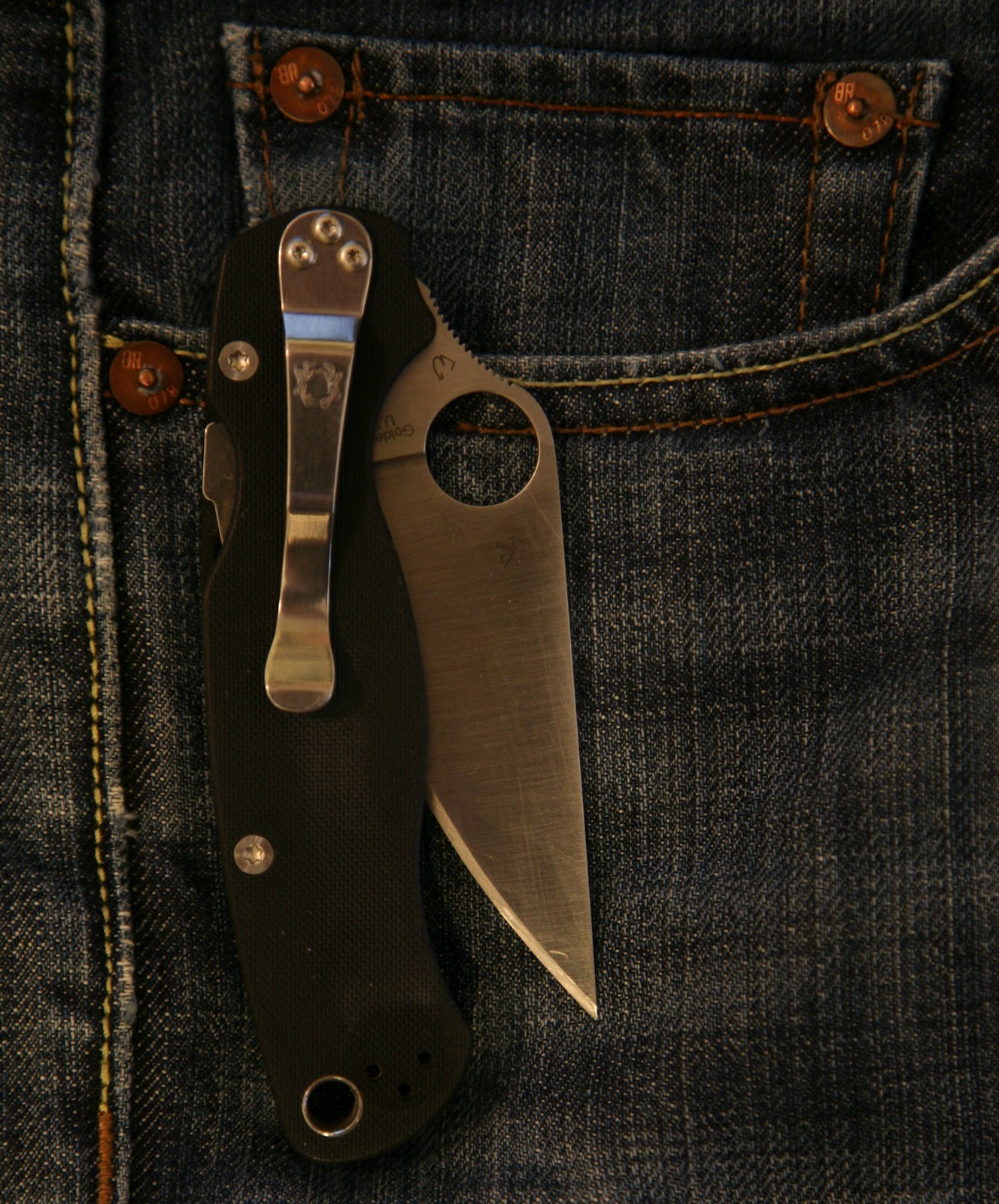
Blade deployment is a problem in tip-down forward carry. As seen, the blade may open unhindered and can pose a hazard.

Tip-down rearward carry. A decent solution, but deployment after retrieval is complicated by the opening hardware (here a thumb-hole) facing in the wrong direction.

It's unlikely that the blade would open, as depicted, as the rear seam of the pocket acts as a barrier.

Tip-up rearward carry. By far, the best option. Deployment following retrieval is uninhibited and the potential for the blade to unintentionally open in the pocket is minimized.

As with all blade-rear carry, the potential for unintentional opening is nearly zero; the rear seam of the pocket effectively mitigates the risk.
Carry tip-up blade-rear. You don't have a good reason to do otherwise.
6/29/12
Spyderco Para-Military2 Knife Review
I've had an opportunity to kick the Spyderco Para-Military2 around the block for a good while and figured it was time to type up the review.
I unboxed it here and, suffice it to say, I've only grown more attached.
The Para-Military2 is a hot topic. It seems like many people are buzzing about its design and quality. I will be not be an exception to this trend, it seems.
Of course, I'm using the template found here.

Blade Material: 2
S30V. A great steel in all respects. S30V touts great edge retention, toughness, and corrosion resistance. The steel is hard enough to keep a razor edge through firm use without being so brittle as to chip or splinter when encountering harder materials.
Sharpening was a breeze and I achieved a shaving sharp edge with relative ease (using a Smith's fine diamond stone initially and finishing with a fine Arkansas). I have found it easier to obtain exceptionally sharp results with S30V than with any of the other steels I've sharpened. Perhaps this is because S30V can simply take a sharper edge than its softer brethren or perhaps its some fluke in my perception. Either way, I'm quite content.

Fit of Parts: 2
The Para-Military2 is the first Spyderco knife I own. It's exceptionally well constructed. There is nothing to complain about with respect to how this knife fits together.
When I first moved the pocket clip to the position I desired it had some side-to-side wiggle but this was remedied by torquing the screws down a bit more (I have since learned that I don't need to be gentle). After tightening down the pocket clip I haven't experienced any movement in it whatsoever.
Blade Shape: 2
It's an excellent EDC blade, that's for sure. The blade has sufficient belly for great slicing and a pronounced point for penetrating material.
Also worth noting is that the blade length is a great size. It's not too long to be awkward (in terms of either manipulation or social perception) and just long enough to be useful in more than minor instances. I feel good using this knife for everything from minor tasks (like cutting an errant thread from my shirt) to more major work (say, feathering kindling and splitting firewood, if you're so inclined).
The tip of the blade is relatively thin. I haven't encountered any problems with it and I don't expect to run into any tasks which will compel me to use the knife as a pry-bar.
The shape, in terms of design, is quite nice. Most of the Spyderco blades I've seen have sort of an organic feel to them, the Para-Military2 is no exception.
Blade Grind: 2
The Spyderco Para-Military2 features a full flat-ground blade. The blade starts thick at the spine and tapers at a consistent angle to the edge. It's a great shape. I haven't had any problems with durability. I've used the spine to pop caps off bottles without incident and the blade has hacked through some pretty dense firewood without skipping a beat.
It should be noted that the Para-Military2 sports an incredibly clean and consistent grind. I don't think I would except anything less from Spyderco, but other knives I own don't appear to be manufactured with as exacting tolerances.
Mechanism: 2
The Para-Military2 uses a compression lock. It is incredibly well designed allowing one to close the blade one-handed without placing any fingers between the blade's edge and the handle. This is a feature that I am in love with. I'm finding it far more convenient to use than a traditionally placed lock (that must be accessed from the "front" of the knife).
More importantly, it seems to me that the placement of the lock allows the user more positive control over the knife when closing the blade. Closing a "traditionally" placed lock (typically a liner-lock or frame-lock) one-handed compels the user to flip the blade towards his fingers and, at least in my experience, execute a well choreographed finger ballet to maintain control of the knife and maintain the integrity of various fingers. On some knives this ballet is more of a problem than others. The Para-Military2, however, avoids this problem all together with its locking mechanism.
Also, the blade action is so smooth that it's possible to simply disengage the lock with the blade in a semi-upright position and have the blade effortlessly swing closed.

Design Concept: 2
If I had to describe the Para-Military2 in a word it would be "refined."
From the overarching concept to the minor details, the Para-Military2 is exceptionally well-thought. The design itself is a refinement of the original "Military" knife, still available from Spyderco. According to their product description, the Para-Military2 is the result of a desire to refine the Military into a better product, enhancing its ergonomics and cutting ability to produce a superior knife.
The aesthetics of the Para-Military2 are great, in my opinion. It's clean and streamlined. It has beautiful curves that are purposefully crafted. Its form is dictated, it would seem, by its function. A great marriage of usefulness and aesthetics.
Grip: 2
There are a couple things to mention here. First, the handle is constructed from G10. The texture of the G10 is exceptional; there's just enough bite to provide a non-slip grip without being irritating in the slightest. Even with with slight pressure my grip seems secure. Second, the handle shape is great. It contours in just the right places facilitating various grip methods (both a traditional forward grip and a reverse grip feel excellent). Finally worth noting are the finger choil and spine jimping. These features allow one to choke up on the blade with ease and comfort making detail work a cinch.
Some have complained, or at least noted potential problems, with the handle area around the compression lock. It has been said that the thinner handle area could be a source of significant discomfort when using the knife for prolonged periods of slicing (particularly through harder materials). While I haven't used this knife too extensively for slicing through dense material, I haven't noticed any discomfort in the time I've been using the knife. In gripping the knife it's certainly evident that the handle section is thinner around the compression lock, but it hasn't become uncomfortable.
Deployment Method: 2
Being my first Spyderco, this is the first knife I have owned (or even used) with a thumb hole. Within minutes of playing with it out of the box I knew I liked it and after carrying it for the past month or so I can say that I've been convinced it's the best manual opening device out there. One simply pushes the tip of the thumb into the thumb hole and flicks forward, opening the knife.
The thumb hole on the Para-Military2 is 14mm in diameter. Spyderco lists it as 14mm on their documentation and I don't have the tech to verify their measurement (digital calipers are on my wishlist...). It's a good size, I think, allowing easy function even with gloved hands (I've been using a pair of Mechanix Original gloves).
The action on the Para-Military2 is incredibly smooth. The blade swings open almost instantly with the flick of the thumb. I have to say it's more addicting than any of the assisted opening actions that are in my drawer.
Carry Method: 2
The Para-Military2 sports a four-position pocket clip. As such, it's possible to carry tip-up or tip-down on the left or the right. I have it configured for tip-up carry on the right hand side; I can't fathom why anyone would want to carry this knife tip-down.
Just enough of the knife sticks up above the pocket to facilitate a strong purchase for retrieval while not making the knife feel less-than-secure. The pocket clip is well-constructed and provides sufficient retention; I am in no way concerned that this knife is going to find its way out of my pocket nor do I believe the pocket clip is going to become looser in the near or distant future.
There is also a prominent lanyard hole on the knife. It has an internal diameter of about 6mm, or in more practical terms, it can accommodate three strands of 550 paracord. Adding a lanyard could facilitate quicker retrieval but I don't think it's really necessary for most purposes. It really boils down to personal preference and I have no need for a lanyard in my everyday carry.

Carry Comfort: 2
The knife is exceptionally light compared to others of the same size that I own. This makes it quite the pleasure to carry. It sits nicely and doesn't move unless asked.
Moreover, the Para-Military2 is relatively slim coming in at about 12mm. It doesn't feel bulky in the pocket and has been exceptionally comfortable to carry.
Total: 20/20
The Spyderco Para-Military2 is the best, most exciting knife that I currently own or have had an opportunity to play with. I do not have any complaints about this blade. It has been in my pocket for a while and will remain there for the foreseeable future.
I highly recommend this as an everday carry blade. For the money (around $110.00 on Amazon) it's a bargain.

I unboxed it here and, suffice it to say, I've only grown more attached.
The Para-Military2 is a hot topic. It seems like many people are buzzing about its design and quality. I will be not be an exception to this trend, it seems.
Of course, I'm using the template found here.

Blade Material: 2
S30V. A great steel in all respects. S30V touts great edge retention, toughness, and corrosion resistance. The steel is hard enough to keep a razor edge through firm use without being so brittle as to chip or splinter when encountering harder materials.
Sharpening was a breeze and I achieved a shaving sharp edge with relative ease (using a Smith's fine diamond stone initially and finishing with a fine Arkansas). I have found it easier to obtain exceptionally sharp results with S30V than with any of the other steels I've sharpened. Perhaps this is because S30V can simply take a sharper edge than its softer brethren or perhaps its some fluke in my perception. Either way, I'm quite content.

Fit of Parts: 2
The Para-Military2 is the first Spyderco knife I own. It's exceptionally well constructed. There is nothing to complain about with respect to how this knife fits together.
When I first moved the pocket clip to the position I desired it had some side-to-side wiggle but this was remedied by torquing the screws down a bit more (I have since learned that I don't need to be gentle). After tightening down the pocket clip I haven't experienced any movement in it whatsoever.
Blade Shape: 2
It's an excellent EDC blade, that's for sure. The blade has sufficient belly for great slicing and a pronounced point for penetrating material.
Also worth noting is that the blade length is a great size. It's not too long to be awkward (in terms of either manipulation or social perception) and just long enough to be useful in more than minor instances. I feel good using this knife for everything from minor tasks (like cutting an errant thread from my shirt) to more major work (say, feathering kindling and splitting firewood, if you're so inclined).
The tip of the blade is relatively thin. I haven't encountered any problems with it and I don't expect to run into any tasks which will compel me to use the knife as a pry-bar.
The shape, in terms of design, is quite nice. Most of the Spyderco blades I've seen have sort of an organic feel to them, the Para-Military2 is no exception.
Blade Grind: 2
The Spyderco Para-Military2 features a full flat-ground blade. The blade starts thick at the spine and tapers at a consistent angle to the edge. It's a great shape. I haven't had any problems with durability. I've used the spine to pop caps off bottles without incident and the blade has hacked through some pretty dense firewood without skipping a beat.
It should be noted that the Para-Military2 sports an incredibly clean and consistent grind. I don't think I would except anything less from Spyderco, but other knives I own don't appear to be manufactured with as exacting tolerances.
Mechanism: 2
The Para-Military2 uses a compression lock. It is incredibly well designed allowing one to close the blade one-handed without placing any fingers between the blade's edge and the handle. This is a feature that I am in love with. I'm finding it far more convenient to use than a traditionally placed lock (that must be accessed from the "front" of the knife).
More importantly, it seems to me that the placement of the lock allows the user more positive control over the knife when closing the blade. Closing a "traditionally" placed lock (typically a liner-lock or frame-lock) one-handed compels the user to flip the blade towards his fingers and, at least in my experience, execute a well choreographed finger ballet to maintain control of the knife and maintain the integrity of various fingers. On some knives this ballet is more of a problem than others. The Para-Military2, however, avoids this problem all together with its locking mechanism.
Also, the blade action is so smooth that it's possible to simply disengage the lock with the blade in a semi-upright position and have the blade effortlessly swing closed.

Design Concept: 2
If I had to describe the Para-Military2 in a word it would be "refined."
From the overarching concept to the minor details, the Para-Military2 is exceptionally well-thought. The design itself is a refinement of the original "Military" knife, still available from Spyderco. According to their product description, the Para-Military2 is the result of a desire to refine the Military into a better product, enhancing its ergonomics and cutting ability to produce a superior knife.
The aesthetics of the Para-Military2 are great, in my opinion. It's clean and streamlined. It has beautiful curves that are purposefully crafted. Its form is dictated, it would seem, by its function. A great marriage of usefulness and aesthetics.
Grip: 2
There are a couple things to mention here. First, the handle is constructed from G10. The texture of the G10 is exceptional; there's just enough bite to provide a non-slip grip without being irritating in the slightest. Even with with slight pressure my grip seems secure. Second, the handle shape is great. It contours in just the right places facilitating various grip methods (both a traditional forward grip and a reverse grip feel excellent). Finally worth noting are the finger choil and spine jimping. These features allow one to choke up on the blade with ease and comfort making detail work a cinch.
Some have complained, or at least noted potential problems, with the handle area around the compression lock. It has been said that the thinner handle area could be a source of significant discomfort when using the knife for prolonged periods of slicing (particularly through harder materials). While I haven't used this knife too extensively for slicing through dense material, I haven't noticed any discomfort in the time I've been using the knife. In gripping the knife it's certainly evident that the handle section is thinner around the compression lock, but it hasn't become uncomfortable.
 |
| Spine jimping on the Para-Military2. |
Deployment Method: 2
Being my first Spyderco, this is the first knife I have owned (or even used) with a thumb hole. Within minutes of playing with it out of the box I knew I liked it and after carrying it for the past month or so I can say that I've been convinced it's the best manual opening device out there. One simply pushes the tip of the thumb into the thumb hole and flicks forward, opening the knife.
The thumb hole on the Para-Military2 is 14mm in diameter. Spyderco lists it as 14mm on their documentation and I don't have the tech to verify their measurement (digital calipers are on my wishlist...). It's a good size, I think, allowing easy function even with gloved hands (I've been using a pair of Mechanix Original gloves).
The action on the Para-Military2 is incredibly smooth. The blade swings open almost instantly with the flick of the thumb. I have to say it's more addicting than any of the assisted opening actions that are in my drawer.
Carry Method: 2
The Para-Military2 sports a four-position pocket clip. As such, it's possible to carry tip-up or tip-down on the left or the right. I have it configured for tip-up carry on the right hand side; I can't fathom why anyone would want to carry this knife tip-down.
Just enough of the knife sticks up above the pocket to facilitate a strong purchase for retrieval while not making the knife feel less-than-secure. The pocket clip is well-constructed and provides sufficient retention; I am in no way concerned that this knife is going to find its way out of my pocket nor do I believe the pocket clip is going to become looser in the near or distant future.
There is also a prominent lanyard hole on the knife. It has an internal diameter of about 6mm, or in more practical terms, it can accommodate three strands of 550 paracord. Adding a lanyard could facilitate quicker retrieval but I don't think it's really necessary for most purposes. It really boils down to personal preference and I have no need for a lanyard in my everyday carry.

Carry Comfort: 2
The knife is exceptionally light compared to others of the same size that I own. This makes it quite the pleasure to carry. It sits nicely and doesn't move unless asked.
Moreover, the Para-Military2 is relatively slim coming in at about 12mm. It doesn't feel bulky in the pocket and has been exceptionally comfortable to carry.
Total: 20/20
The Spyderco Para-Military2 is the best, most exciting knife that I currently own or have had an opportunity to play with. I do not have any complaints about this blade. It has been in my pocket for a while and will remain there for the foreseeable future.
I highly recommend this as an everday carry blade. For the money (around $110.00 on Amazon) it's a bargain.

5/14/12
Spyderco Para-Military2 - Unboxing and Initial Impressions

A box arrived in the mail today. I absolutely love boxes.
Earlier last week I was browsing the internet, as usual, and discovered that Amazon.com had a wonderful offer on the Spyderco Para-Military2. I casually mentioned this fact to my girlfriend, Megan, and minutes later I received an email confirming an order. Unintended, unexpected, and incredibly appreciated.
Unboxing
 |
| Over-packaging 101 |
As a quick aside, Amazon seems to have an obsession with over-boxing things. They use far larger boxes than one might assume was necessary. Perhaps my comprehension of shipping methodology is lacking...
In any event, the Para-Military2 is packaged in a little cardboard box with Spyderco logo embellishments. Typical knife packaging for a not-so-typical knife.
Included in the box is a short pamphlet delineating the changes made between the classic version and the updated second version of the knife. Also included in the box is, of course, the Spyderco Para-Military2.

Initial Impressions
This is my first Spyderco knife. I've heard exceptional things about their knives but haven't had the pleasure of owning one, until now.
The first thing I noticed was the weight of the knife. I expected it to be a bit heavier. I must say that the lighter weight is a pleasant surprise. After tossing it in my pocket and running some errands it was clear that the knife is going to all but disappear when clipped to my pocket.
I really like the aggressive texture on the G-10 handles. They're very non-slip but not to the point of discomfort. The jimping on the spine of the knife and the finger choil is a nice touch.
As I said, this is my first Spyderco. As such, I don't have any prior experience with Sypyderco's trademark hole (although, from a legal perspective I wonder if it could be challenged alleging that it's a functional feature that hasn't acquired a strong enough secondary meaning to be eligible for trademark protection; that's beside the point, though). From my brief experience with it I am exceptionally impressed. It facilitates a very quick opening.
The Para-Military2 employs a compression lock. It's a bit new for me, though, as it unlocks on the back of the knife, as opposed to the front, where one finds most liner and frame locks (encompassing most of my collection, currently). This allows the user to close the knife without putting fingers in front of the blade. Great design, in my opinion.
Also worth mentioning is the fact that simply disengaging the liner lock while the knife is in a slightly vertical position causes the blade to gracefully swing closed. I love it.
The blade shape is pretty. It's a nice departure from the "traditional" shape to which I have become accustomed. It has a great point and sufficient belly for great slicing, as far as I can tell.
The Para-Military2's blade is ground from CPM-S30V steel. S30V screams high-end. It's a fantastic blade steel and the Para-Military2 is the first knife I'll own that's constructed from it.
The pocket clip is capable of being mounted for tip up or tip down, left or right side carry. Straight out of the box I unscrewed it and mounted the clip for tip up right side carry. I always carry a knife in my right front pocket and prefer tip up carry for reasons I won't get into here (I keep saying that I won't get into something here, I should start getting into it somewhere else, I think).
The Para-Military2 features a sizable lanyard hole. I don't think I'll be using it anytime soon, but it's there if I ever want to attach something.
I really look forward to carrying this knife. It's going straight into my pocket and isn't likely to be replaced in the near or distant future. It's in the review pipeline behind a bunch of other things - keep on the lookout.
Included in the box is a short pamphlet delineating the changes made between the classic version and the updated second version of the knife. Also included in the box is, of course, the Spyderco Para-Military2.

Initial Impressions
This is my first Spyderco knife. I've heard exceptional things about their knives but haven't had the pleasure of owning one, until now.
The first thing I noticed was the weight of the knife. I expected it to be a bit heavier. I must say that the lighter weight is a pleasant surprise. After tossing it in my pocket and running some errands it was clear that the knife is going to all but disappear when clipped to my pocket.
I really like the aggressive texture on the G-10 handles. They're very non-slip but not to the point of discomfort. The jimping on the spine of the knife and the finger choil is a nice touch.
 |
| Golden, Colorado U.S.A. Earth; nice touch... |
As I said, this is my first Spyderco. As such, I don't have any prior experience with Sypyderco's trademark hole (although, from a legal perspective I wonder if it could be challenged alleging that it's a functional feature that hasn't acquired a strong enough secondary meaning to be eligible for trademark protection; that's beside the point, though). From my brief experience with it I am exceptionally impressed. It facilitates a very quick opening.
The Para-Military2 employs a compression lock. It's a bit new for me, though, as it unlocks on the back of the knife, as opposed to the front, where one finds most liner and frame locks (encompassing most of my collection, currently). This allows the user to close the knife without putting fingers in front of the blade. Great design, in my opinion.
Also worth mentioning is the fact that simply disengaging the liner lock while the knife is in a slightly vertical position causes the blade to gracefully swing closed. I love it.
 |
| The liner locking mechanism on the Para-Military2 |
The Para-Military2's blade is ground from CPM-S30V steel. S30V screams high-end. It's a fantastic blade steel and the Para-Military2 is the first knife I'll own that's constructed from it.
The pocket clip is capable of being mounted for tip up or tip down, left or right side carry. Straight out of the box I unscrewed it and mounted the clip for tip up right side carry. I always carry a knife in my right front pocket and prefer tip up carry for reasons I won't get into here (I keep saying that I won't get into something here, I should start getting into it somewhere else, I think).
The Para-Military2 features a sizable lanyard hole. I don't think I'll be using it anytime soon, but it's there if I ever want to attach something.
I really look forward to carrying this knife. It's going straight into my pocket and isn't likely to be replaced in the near or distant future. It's in the review pipeline behind a bunch of other things - keep on the lookout.
5/7/12
Svord Peasant Knife Review
I picked up the Svord Peasant Knife on a whim a few weeks back. It seemed like something that would be worth having and I find friction folders intriguing
I unboxed it here and posted some initial photos of its original configuration.
I added a pocket clip made from scrap steel and a lanyard from paracord. I'm evaluating the knife as if it didn't have a pocket clip as that is how it originally arrived in my hands.
Of course, I'm using the review template found here.

Blade Material: 1
Apparently the blade is fabricated from Sandvik L6 steel. L6 is a high-carbon tool steel. From what I've read it's pretty robust in terms of edge retention and the like. However, it's not "stainless." It will rust easily if not cared for. And, of course, you are consistently touching the blade with your fingers - the oils that you're depositing on the blade don't do it well.
In my limited experience with it (trying to clean up the edge and sharpening it after use a few times) it hasn't been too difficult to work with. It's quite possible to get an incredibly sharp edge out of the L6 and the steel holds onto it for quite a while.
Fit of Parts: 1
The PK uses a very simple design which requires a bit of play between the handle sections to function properly. I adjusted my PK a bit, loosening the rear screw (so the blade isn't held as tight when it's closed) and kept the other two screws a bit tighter (so the blade "locks" up with a bit more force). In doing this the bottom of the handle is a bit more "loose" than it otherwise could be but, if I were to tighten that screw down it would inhibit deployment of the blade far too much.
That said, the hardware doesn't fit as tightly as it could. The pivot screw, for example, has a bit of play that doesn't contribute to the functionality of the joint.

Blade Shape: 2
The PK sports something in between a straight-back and a drop-point blade. In terms of an EDC blade, I think this sort of blade shape is among the best available. It has sufficient belly and a nice taper to the point.
The spine of the knife has a consistent thickness down the whole of the blade.
The plain edge is something that I'm growing increasingly fond of in an EDC blade; I do not intend to purchase any more partially serrated blades for reasons too lengthy to discuss here.
Blade Grind: 0
Using what could be be described as a flat grind, the blade of the PK maintains a relatively consistent width down the spine and tapers down to the edge. This makes the majority of the blade robust and should contribute to durability. It's evident that the grind isn't perfectly consistent when comparing one side to another. This isn't necessarily detrimental to the performance of the knife and does seem to add to the peasant-like character that Svord is aiming to achieve.
Moreover, the edge that was on the blade from the factory was a bit off-centered. This isn't too annoying but is going to take a bit of time to clean up.
While I do believe the "humble" intent of the designers influenced the blade and edge grind I can't help but assess a zero in this category. The same look could have been accomplished without sacrificing a precise grind.
Mechanism: 1
The PK is a friction-folder meaning there is no locking mechanism, per se; the blade stays open and closed as a result of friction between the handle sections and the blade. Friction-folders are gaining popularity in many places as a result of legislatures attempting to regulate criminal behavior by banning locking knives. Efficacy of such bans aside, the friction-folder is and should be a timeless design.
It's profoundly simple yet yields a remarkably sturdy "lock up," for lack of a better term. It's not infallible but it's certainly strong and safe enough for most everyday uses. Gripping the knife by the handle only enhances the safety of the blade as your hand is placing pressure on the tang, preventing the blade from closing.
The "middle screw," as it were, operates to prevent the knife from opening "too far," causing the tang to be buried between the handle sections, and also prevents the blade from closing "too far," which would cause the very tip of the knife to engage with the bottom screw. In that regard, this is a very well thought design.
With that in mind, the design can be a bit troublesome. If, as I have, the handle sections are loosened enough to facilitate relatively easy opening the knife is prone to opening slightly during carry. Of course, if I tighten down the system to prevent it from opening slightly in the pocket it becomes far more difficult to open and close. In that regard, it could be slightly better.
Design Concept: 1
It's a noble design using the nothing more than the most fundamental aspects of a folding knife.
It's a great little design for everyday utility use. It's also relatively benign-looking; it's not a knife which is going to engender tons of odd looks because it's "overly tactical" or has a blade profile which looks incredibly aggressive. In that respect, it's a good design for everyday carry because it won't raise too many eyebrows.

Grip: 1
The design of the handle strongly reminds me of a jalapeno.
I try to choke up as much on the blade as I can which places the wider portion of the handle behind my index and middle fingers. This gives me a decent bit of control over the blade.
The grip isn't particularly comfortable; the slim aluminum handles are probably the least comfortable of the various styles available (the other two being molded polypropylene and wood). That said, it's not more uncomfortable than other folders I've handled.
Deployment Method: 1
I've seen a bunch of different methods to open this knife one-handed. All of them are somewhat clunky. That said, you don't have to open it with one hand. Sure, the ability to open a knife with one hand is a great feature but it's not a make-or-break element.
My preferred method of deployment for the PK has been resting the bottom of the handle in the palm of my left hand, wrapping my thumb over the bottom of the handle, and applying torque to the tang with my right hand. I close the knife in much the same manner, but with torque applied to the spine of the blade.
I have no problem opening and closing this knife. If you adjust the tension of the screws you can make to easier or more difficult to open.
If you desperately need a knife that you can easily operate one-handed, this isn't the blade for you.
Carry Method: 1
 As it comes, the PK doesn't have a pocket clip. It'll settle to the bottom of whatever pocket you put it in, for better or worse. In the jeans I consistently wear the tang of the PK still protrudes slightly from the top of my pocket when it has settled to the bottom. This is convenient, assuming your pockets are the same depth as mine.
There is a lanyard hole on the end of the tang. This would allow you to loop a piece of paracord or leather through it, make a
Carry Comfort: 2
This knife is slim. With the aluminum handles, the thickest part of the knife is the blade itself. It practically disappears in a pocket. Also important to note, it's lightweight. When I've carried it it's practically unnoticeable. Due to its slim width it doesn't print too much either; were it not for the lanyard it would be nearly imperceptible to the casual passerby.
One concern with the PK is, as mentioned, the possibility that it will open slightly in the pocket. This can be prevented by tightening the hardware. I don't feel that I can really dock points because of the tension I was running the hardware at, so I'm just avoiding the problem with respect to carry comfort.
Total: 11/20
The Svord Peasant Knife is neat. It has been exceptionally fun and incredibly easy to play around with. If you're willing to give this guy the attention it's a great blade for the price. I do plan to purchase another with a polypropylene handle and perhaps the wood version, too; hey, for under 20 bucks it's absolutely worth it.
In any event, I'm not planning to keep it in my pocket; I'll stick to my smaller locking folders for the most part. On the off chance that I'm compelled into a jurisdiction that frowns on locking folders I'll toss it in my pocket but short of that I'll just keep it around for the occasional task.
5/4/12
< 101 - Shifty Blade Shapes?
There are certain perceptions about knives that we can’t avoid; some people simply assume the worst when they see someone using anything but a butter knife. It’s a simple fact: knives turn heads, even when their use is entirely appropriate.
What’s interesting, though, is how blade shape can affect perception. There are blades that simply look more “mean” than others.
Tanto blades, for example, seem to attract more unwanted attention than spear or drop points. Somehow those blade shapes are more benign. More “aggressive” blade shapes seem to beget looks of concern faster than “softer” shapes.
Something to think about...
What’s interesting, though, is how blade shape can affect perception. There are blades that simply look more “mean” than others.
Tanto blades, for example, seem to attract more unwanted attention than spear or drop points. Somehow those blade shapes are more benign. More “aggressive” blade shapes seem to beget looks of concern faster than “softer” shapes.
Something to think about...
5/2/12
Columbia River Knife and Tool M16-14SFG Knife Review
I received my Columbia River Knife and Tool M16-14SFG a few years ago as a gift from my girlfriend. I’ve carried it extensively, used it a good amount, and thought it would be a good candidate for my first knife review.
I'm using the template I outlined here for this and all other knife reviews.
Blade Material: 1
The blade is manufactured from 8Cr14MoV steel. From what I’ve read it’s a little harder than the widely-used AUS-8 steel. While it doesn’t compare to the edge-retention of VG-10 or S30V it’s a bit easier to put and keep an edge on.
In my personal experience it's easy to sharpen and keeps its edge relatively well.
I did damage the blade early in my ownership. I was making a feather stick and neglected to realize someone had driven a nail into the middle. Needless to say, I caught it with the blade and it produced a sizable nick. I took a coarse diamond stone to it and repaired it with relative ease. There's no doubt the ease of repair was facilitated by the slightly softer steel (whereas a harder steel, like S30V, would have been far more difficult to clean up).
Ultimately, it’s not a high-end steel, but it seems to be a good all-around performer.
Fit of Parts: 2
Everything fits together nicely on this knife. I've owned and used this knife for quite a while and it hasn't loosened. The action is as smooth as it was fresh out of the box (maybe even better now that it has been broken in a bit).
I initially had some concerns about the AutoLAWKS device, thinking that it might become damaged, loosen up, or otherwise lose functionality over time. This has not been the case.
Blade Shape: 1
 The M16-14SFG uses a tanto-style blade. It’s also partially serrated with CRKT's proprietary “veff” serrations.
In terms of an EDC knife, the tanto blade shape isn’t optimum. It’s lacking in the slicing department and because of the serrations it’s not a great performer when it comes to detail work either.
That said, it’s still a pretty good blade.
The veff serrations are a nice design but leave a little bit to be desired. They're super sharp and do seem to get through fibrous materials with ease. The trouble is, they're VERY delicate. The points are prone to bending even when cutting through relatively easy material (cardboard, for example, caused a couple tips to curve a bit). Maybe a harder steel would be a better choice when executing this design.
I strongly believe that a plain edge would be a better overall performer. Getting rid of the serrations entirely would almost indubitably yield a better knife.
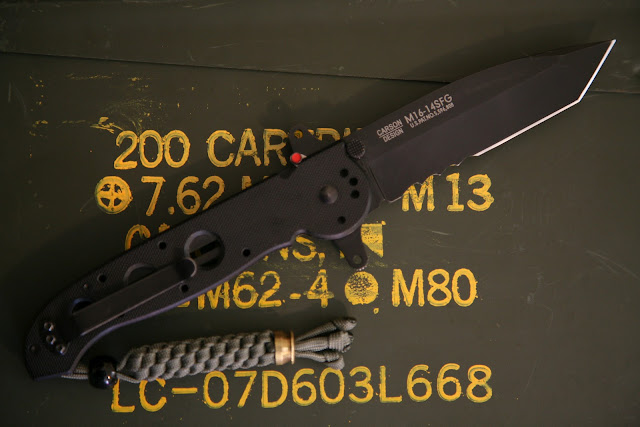
Blade Grind: 2
The knife has what I believe to be a sabre grind. The spine of the knife is large and extends straight down toward the cutting edge approximately ⅖ of the blade. The blade then tapers to the edge. CKRT states on the product page that the knife sports a hollow grind from the factory but I’m not convinced. If there is a hollow grind it’s very conservative and practically imperceptible. Even so, a hollow grind isn’t the best choice for an everyday carry knife; I’m more interested in something that’s going to hold up to the rigors of daily use. The CRKT M16-14SFG’s grind does just that.
Mechanism: 2
The M16-14SFG utilizes a liner-lock made of 2CR12 steel. I haven’t found much material regarding the properties of this steel but I haven’t encountered any problems with it. The lock-bar itself is skeletonized. It sets up nicely when the blade is opened and doesn't engage too far (which would mechanically limit its locking abilities). When pressure is applied to the spine of the blade the lock bar does, of course, flex slightly but I haven't gotten it to shift along the bottom of the blade.
This knife also uses CRKT’s “AutoLAWKS” system. Essentially, it’s a small lever system which springs into place when the blade is opened. It functions to prevent the liner-lock from being disengaged inadvertently. CRKT considers this to mimic the functionality of a fixed-blade. While it does make it more difficult for the lock to fail I’m not convinced that it’s as bomb-proof as a true fixed-blade.
The lock bar functions as it should and the AutoLAWKS system makes it more secure than “plain” liner-locks without making it more difficult to operate. For those reason, I’m assessing a 2 for this category.
Design Concept: 1
I’m relatively impressed by the design of many CRKT knives, the M16-14SFG isn’t an exception. Its form is dictated predominantly by function, a design philosophy I quite like. I can’t say that it’s the most attractive knife I’ve ever seen, though.
The large holes in the handle are there to reduce weight. The smaller holes, those that aren't there for screwing down the pocket clip, are there for aesthetics, as far as I can tell.
Grip: 1
The grip on the M16-14SFG is well-designed. It's a relatively large knife, so there's no problem with the grip being too small. This is one of the few folders out there that features a hilt. It's a convenient feature for some tasks but can also be a bother. The hilt created by the flippers makes it difficult to choke up on the blade for detail work and forces distance between the grip and the blade.
I don't find myself in situations where I'm concerned that my hand will slip over the blade while I'm using the knife.
Deployment Method: 2
The knife does employ a thumb-stud but it’s practically useless. My preferred deployment method is the flipper. With a quick snap of the index finger the blade deploys. Keep the joint well-oiled and the blade can deploy as fast or faster than any assisted opening knife I've ever used.
I had contemplated giving the deployment method a 1 simply because the thumb-stud isn’t useful for opening but the flipper is just so wonderful. You can’t go wrong with it.
An added bonus (legally questionable here in MA) is the ability to use the flipper to deploy the knife as you're pulling it out of your pocket. It is possible, if you're thinking about it, to catch the flipper on the back edge of your front pocket while removing the knife and cause the blade to open. I'm not convinced it was designed to do this but it's possible.
Carry Method: 2
There is a four position pocket clip on the M16-14SFG. It can be carried tip-up or -down, left or right. I prefer to carry tip-up for reasons I won’t articulate here. If, however, I were to orient the clip to carry tip-down the flippers would sit at the top of the pocket and would, as far as I’m concerned, get in the way.
The clip itself is sturdy and affixed to the body of the knife by three screws. It's at a height where it doesn't seem like too much of the handle is exposed. It's not necessarily "discrete," but it's certainly slim enough to sit in a pocket without attracting too much attention. I don't concern myself too much with the concealment of knives; not many people pay attention to what's in other people's pockets and, fortunately, the jurisdiction in which I live isn't as nutty about knives as others.
For tip-up carry, as I choose to carry it, this knife has to be a 2. The clip is well-executed and the ability to universally orient it is convenient. It carries with just enough handle outside the pocket; enough to get a decent purchase on it but not so much that it's too exposed or feels poorly secured.
Carry Comfort: 1
The knife is pretty slim which contributes greatly to its comfort. It is a rather large knife, but it doesn't seem it when in my pocket.
The flippers are the biggest complaint I have when it comes to carry comfort. Naturally, the flippers stick out well beyond the handle of the knife; they take up ample real estate in whatever pocket the knife is carried. Also, they can damage other things in the pocket. For example, I often carry the knife in my right front pocket along with my wallet. The flipper rubs up against the side of the wallet and erodes the material. While it hasn't caused catastrophic damage it's working its way in that direction. Sure, I could move the knife, and I have (I carry it in my right back pocket now) but anything placed in the pocket with it will be affected. The flippers really monopolize the whole pocket.
If the knife was carried tip-down with the flippers at the top the damage problem probably wouldn't exist but they would inhibit access to the pocket (the width of the hilt created by the flippers is approximately 2.25 inches; that's a lot of space).
TOTAL: 15/20
This is a great knife. It's affordable and well-made. Some might find it a bit too big for everyday carry, but that hasn't been a problem for me. If I could change one thing it would be eliminating the serrations; I'm gradually discovering (as many have) that partially serrated blades are more irritating than useful and this knife is no exception. If I sharpen the hell out of it they'll eventually disappear and, with the quality of the build on this knife, I imagine it will last long enough for my dreams to come to fruition.
The M16-14SFG is available online for just under $50.00. At that price it's a steal. It's a great addition to any pocket or bag.
I'm using the template I outlined here for this and all other knife reviews.
 |
| New edge, fresh oil, and a cup of tea; a delightful morning. |
Blade Material: 1
The blade is manufactured from 8Cr14MoV steel. From what I’ve read it’s a little harder than the widely-used AUS-8 steel. While it doesn’t compare to the edge-retention of VG-10 or S30V it’s a bit easier to put and keep an edge on.
In my personal experience it's easy to sharpen and keeps its edge relatively well.
I did damage the blade early in my ownership. I was making a feather stick and neglected to realize someone had driven a nail into the middle. Needless to say, I caught it with the blade and it produced a sizable nick. I took a coarse diamond stone to it and repaired it with relative ease. There's no doubt the ease of repair was facilitated by the slightly softer steel (whereas a harder steel, like S30V, would have been far more difficult to clean up).
Ultimately, it’s not a high-end steel, but it seems to be a good all-around performer.
Fit of Parts: 2
Everything fits together nicely on this knife. I've owned and used this knife for quite a while and it hasn't loosened. The action is as smooth as it was fresh out of the box (maybe even better now that it has been broken in a bit).
I initially had some concerns about the AutoLAWKS device, thinking that it might become damaged, loosen up, or otherwise lose functionality over time. This has not been the case.
Blade Shape: 1

In terms of an EDC knife, the tanto blade shape isn’t optimum. It’s lacking in the slicing department and because of the serrations it’s not a great performer when it comes to detail work either.
That said, it’s still a pretty good blade.
The veff serrations are a nice design but leave a little bit to be desired. They're super sharp and do seem to get through fibrous materials with ease. The trouble is, they're VERY delicate. The points are prone to bending even when cutting through relatively easy material (cardboard, for example, caused a couple tips to curve a bit). Maybe a harder steel would be a better choice when executing this design.
I strongly believe that a plain edge would be a better overall performer. Getting rid of the serrations entirely would almost indubitably yield a better knife.

Blade Grind: 2
The knife has what I believe to be a sabre grind. The spine of the knife is large and extends straight down toward the cutting edge approximately ⅖ of the blade. The blade then tapers to the edge. CKRT states on the product page that the knife sports a hollow grind from the factory but I’m not convinced. If there is a hollow grind it’s very conservative and practically imperceptible. Even so, a hollow grind isn’t the best choice for an everyday carry knife; I’m more interested in something that’s going to hold up to the rigors of daily use. The CRKT M16-14SFG’s grind does just that.
Mechanism: 2
The M16-14SFG utilizes a liner-lock made of 2CR12 steel. I haven’t found much material regarding the properties of this steel but I haven’t encountered any problems with it. The lock-bar itself is skeletonized. It sets up nicely when the blade is opened and doesn't engage too far (which would mechanically limit its locking abilities). When pressure is applied to the spine of the blade the lock bar does, of course, flex slightly but I haven't gotten it to shift along the bottom of the blade.
This knife also uses CRKT’s “AutoLAWKS” system. Essentially, it’s a small lever system which springs into place when the blade is opened. It functions to prevent the liner-lock from being disengaged inadvertently. CRKT considers this to mimic the functionality of a fixed-blade. While it does make it more difficult for the lock to fail I’m not convinced that it’s as bomb-proof as a true fixed-blade.
The lock bar functions as it should and the AutoLAWKS system makes it more secure than “plain” liner-locks without making it more difficult to operate. For those reason, I’m assessing a 2 for this category.
 |
| The red switch of CRKT's AutoLAWKS system. |
Design Concept: 1
I’m relatively impressed by the design of many CRKT knives, the M16-14SFG isn’t an exception. Its form is dictated predominantly by function, a design philosophy I quite like. I can’t say that it’s the most attractive knife I’ve ever seen, though.
The large holes in the handle are there to reduce weight. The smaller holes, those that aren't there for screwing down the pocket clip, are there for aesthetics, as far as I can tell.
Grip: 1
The grip on the M16-14SFG is well-designed. It's a relatively large knife, so there's no problem with the grip being too small. This is one of the few folders out there that features a hilt. It's a convenient feature for some tasks but can also be a bother. The hilt created by the flippers makes it difficult to choke up on the blade for detail work and forces distance between the grip and the blade.
I don't find myself in situations where I'm concerned that my hand will slip over the blade while I'm using the knife.
Deployment Method: 2
The knife does employ a thumb-stud but it’s practically useless. My preferred deployment method is the flipper. With a quick snap of the index finger the blade deploys. Keep the joint well-oiled and the blade can deploy as fast or faster than any assisted opening knife I've ever used.
I had contemplated giving the deployment method a 1 simply because the thumb-stud isn’t useful for opening but the flipper is just so wonderful. You can’t go wrong with it.
An added bonus (legally questionable here in MA) is the ability to use the flipper to deploy the knife as you're pulling it out of your pocket. It is possible, if you're thinking about it, to catch the flipper on the back edge of your front pocket while removing the knife and cause the blade to open. I'm not convinced it was designed to do this but it's possible.
Carry Method: 2
 |
| Front pocket carry. |
 |
| Back pocket carry. |
The clip itself is sturdy and affixed to the body of the knife by three screws. It's at a height where it doesn't seem like too much of the handle is exposed. It's not necessarily "discrete," but it's certainly slim enough to sit in a pocket without attracting too much attention. I don't concern myself too much with the concealment of knives; not many people pay attention to what's in other people's pockets and, fortunately, the jurisdiction in which I live isn't as nutty about knives as others.
For tip-up carry, as I choose to carry it, this knife has to be a 2. The clip is well-executed and the ability to universally orient it is convenient. It carries with just enough handle outside the pocket; enough to get a decent purchase on it but not so much that it's too exposed or feels poorly secured.
Carry Comfort: 1
The knife is pretty slim which contributes greatly to its comfort. It is a rather large knife, but it doesn't seem it when in my pocket.
The flippers are the biggest complaint I have when it comes to carry comfort. Naturally, the flippers stick out well beyond the handle of the knife; they take up ample real estate in whatever pocket the knife is carried. Also, they can damage other things in the pocket. For example, I often carry the knife in my right front pocket along with my wallet. The flipper rubs up against the side of the wallet and erodes the material. While it hasn't caused catastrophic damage it's working its way in that direction. Sure, I could move the knife, and I have (I carry it in my right back pocket now) but anything placed in the pocket with it will be affected. The flippers really monopolize the whole pocket.
If the knife was carried tip-down with the flippers at the top the damage problem probably wouldn't exist but they would inhibit access to the pocket (the width of the hilt created by the flippers is approximately 2.25 inches; that's a lot of space).
TOTAL: 15/20
This is a great knife. It's affordable and well-made. Some might find it a bit too big for everyday carry, but that hasn't been a problem for me. If I could change one thing it would be eliminating the serrations; I'm gradually discovering (as many have) that partially serrated blades are more irritating than useful and this knife is no exception. If I sharpen the hell out of it they'll eventually disappear and, with the quality of the build on this knife, I imagine it will last long enough for my dreams to come to fruition.
The M16-14SFG is available online for just under $50.00. At that price it's a steal. It's a great addition to any pocket or bag.
4/27/12
Pocket Clip for the Svord Peasant Knife
I like the Svord Peasant Knife because of its simplicity. It's about as basic as you can make a folding blade.
In total, there are eight parts to the thing. I added a ninth.

While the Peasant Knife, sitting at the bottom of the front pocket on my jeans, protrudes enough to grab it (a little over a quarter inch in the jeans I had on at the time), I wanted to make sure that it stuck around.
I figured I could create a simple pocket clip and attach it to the two screws at top of the handle.
Design
It's a simple enough design: just a straight clip with a slight angle on the mounting side to accommodate the angle of the screws with relation to the handle. Because the pivot and "pin" screws have large heads I figured it was necessary to install the clip as cut from the sheet (without necessary bends) and bend it into place after installation. This method saved me the irritation of designing around the large screws.
Fabrication and Installation
I cut the clip from a small piece of scrap steel I had lying around (truth be told, I cannibalized the enclosure of an old internal CD drive). A quick zip with the Dremel and it took form.
I then drilled the mounting holes and cleaned up any rough edges.
Installing it was a breeze. The trickiest part was aligning the threads on the brass hardware. Brass, being a relatively softer metal, can be finicky when it comes to small threaded parts. The last thing I wanted to do was improperly align the threads and strip the screws. That said, it didn't take but a minute to get the knife back together.
After installing the unbent pocket clip (I should have taken a picture; whoops) I proceeded to put the primary bend in it. I used a small round metal file with a diameter of about an eighth of an inch. This ensured that the bend was round and inhibited creasing or breakage.
With the file still in position and the primary bend in place I took a small hammer and gave it a good few whacks thus putting a bit of tension into the clip that otherwise wouldn't be there with a simple 180 degree bend.
Next, I put a small upward bend in the end of the clip to enhance its ability to slide over the lip of a pocket. I also placed a small downward bend in the middle of the clip (just past the mounting screws) so it would be a bit more flush with the handle. I made these bends using the same principle I expressed above: putting an object (flat in these cases) where I desired a bend and applying pressure.
Finally, I cleaned up the corners with a file to prevent snagging.
I took a few pictures of the finished clip. I'm calling it a prototype because I would prefer to use a more robust steel. We'll see how this carries and go from there...
Carry: Initial Impressions
Clipped to the front pocket the tang extends out of the pocket about 1 3/4 inches giving you a decent purchase on it for retrieval. The design of this knife and other friction-folders forces tip-down carry because of the extended tang. I do believe it's possible to install the hardware "backwards," as it were, to facilitate left or right carry (the spine of the blade should always face the "back" of the pocket; this helps prevent unintended opening of the blade on all folding knives).

My biggest problem now is going to be refraining from using the pocket clip enough to score the carry method and comfort of the knife based on its fresh-from-the-factory features...
In total, there are eight parts to the thing. I added a ninth.

While the Peasant Knife, sitting at the bottom of the front pocket on my jeans, protrudes enough to grab it (a little over a quarter inch in the jeans I had on at the time), I wanted to make sure that it stuck around.
I figured I could create a simple pocket clip and attach it to the two screws at top of the handle.
Design
It's a simple enough design: just a straight clip with a slight angle on the mounting side to accommodate the angle of the screws with relation to the handle. Because the pivot and "pin" screws have large heads I figured it was necessary to install the clip as cut from the sheet (without necessary bends) and bend it into place after installation. This method saved me the irritation of designing around the large screws.
Fabrication and Installation
I cut the clip from a small piece of scrap steel I had lying around (truth be told, I cannibalized the enclosure of an old internal CD drive). A quick zip with the Dremel and it took form.
I then drilled the mounting holes and cleaned up any rough edges.
Installing it was a breeze. The trickiest part was aligning the threads on the brass hardware. Brass, being a relatively softer metal, can be finicky when it comes to small threaded parts. The last thing I wanted to do was improperly align the threads and strip the screws. That said, it didn't take but a minute to get the knife back together.
After installing the unbent pocket clip (I should have taken a picture; whoops) I proceeded to put the primary bend in it. I used a small round metal file with a diameter of about an eighth of an inch. This ensured that the bend was round and inhibited creasing or breakage.
With the file still in position and the primary bend in place I took a small hammer and gave it a good few whacks thus putting a bit of tension into the clip that otherwise wouldn't be there with a simple 180 degree bend.
Next, I put a small upward bend in the end of the clip to enhance its ability to slide over the lip of a pocket. I also placed a small downward bend in the middle of the clip (just past the mounting screws) so it would be a bit more flush with the handle. I made these bends using the same principle I expressed above: putting an object (flat in these cases) where I desired a bend and applying pressure.
Finally, I cleaned up the corners with a file to prevent snagging.
I took a few pictures of the finished clip. I'm calling it a prototype because I would prefer to use a more robust steel. We'll see how this carries and go from there...
 |
| Here you can see the three bends placed in the clip. |
 | |
| The finished clip. As you can see, it was necessary to install the clip without bends due to the location and size of the hardware. |
Carry: Initial Impressions
Clipped to the front pocket the tang extends out of the pocket about 1 3/4 inches giving you a decent purchase on it for retrieval. The design of this knife and other friction-folders forces tip-down carry because of the extended tang. I do believe it's possible to install the hardware "backwards," as it were, to facilitate left or right carry (the spine of the blade should always face the "back" of the pocket; this helps prevent unintended opening of the blade on all folding knives).

My biggest problem now is going to be refraining from using the pocket clip enough to score the carry method and comfort of the knife based on its fresh-from-the-factory features...
4/26/12
Svord Peasant Knife Unboxing and Initial Impressions
 |
| Simple packaging for a simple knife. |
I snagged a Svord Peasant Knife with a slim blue handle this past weekend. It arrived in the mail today and, naturally, I snapped some photos.
The Peasant Knife is supposed to be the bare minimum in terms of a blade. Allegedly it's based on a knife design found in Bohemia and Bavaria around three to four hundred years ago. It's "available only to first class peasants."


Initial Impressions
Steel blade, aluminum handle, and brass screws. Simple stuff.
As it's a friction folder there is a tang that extends beyond the handle when the blade is closed and folds in between the handle sections when the blade is open. The tang wedged between the handle sections provides the friction keeping the blade open. The "action" is very tight out of the box; it's possible to adjust the tension by adjusting the screws. I anticipate that it will loosen up with use.
The edge was relatively sharp. I took a few minutes and cleaned it up a bit and it took an acceptable edge. The factory grind is a bit off-center.
 |
| Brass hardware isn't too shabby. |
I'll be throwing it in my pocket for the foreseeable future and I'll be writing a formal review at some point.
 |
| A peasant's knife for a peasant's chores? |
Subscribe to:
Posts (Atom)