Though there seems to be widespread acknowledgement of the everyday carry discipline, there are still plenty of individuals who are unaware of the mindset.
Despite this, nearly everyone carries an assortment of things on their person.
This raises the question: "Can someone be unknowingly 'everyday carrying'?"
The snob in me wants to emphatically say, "No, everyday carry is only a conscious mindset." That's probably the same part of me that spends months researching gear before pulling the trigger on my debit card and ponders the merits of tip-up vs. tip-down carry.
Practically, though, I'm not sure that's the case. If we suppose that everyday carry is simply the attempt to preemptively solve problems then having anything - sunglasses, a tube of lipstick, tissues - is practicing the discipline. Though more casual than some of us, it's still a viable approach.
Certainly, those casual EDCers among us could benefit from a bit of contemplation and refinement but at least they're in the right vein. More people carrying things that they may need means fewer people asking to borrow my flashlight, knife, or pen, and that's just fine.
Showing posts with label Philosophy. Show all posts
Showing posts with label Philosophy. Show all posts

11/12/13
You Don't Need That Many Knives
I mentioned the idea a while back that "you don't need that many knives."
I wanted to elaborate a bit...
The underlying theory of the everyday carry discipline, at least as far as I can manage to define it, is the belief that having a selection of tools on one's person is more beneficial than not. The ability to solve a variety of problems with the things in your pockets being the primary rationale. Naturally, it is impossible, or at least impractical, to carry tools to solve every problem that might arise. As such, tools which have a broad usefulness are often selected over those of a more specific purpose. For this reason, we often see knives, multi-tools, flashlights, pen and paper, and other such things of exceptionally broad utility. These items can be employed in a wide variety of ways to solve a wide variety of problems.
Importantly, an EDC kit also reflects the problems one believes may be encountered on any given day. It is in that individual thread that we see a variety of items of specific utility; a bicycle commuter may carry a patch kit, a photographer may have a lens pen, someone with severe allergies would carry an EpiPen, and so on and so forth.
That said, one of the most prevalent items found in everyday carry kits is a knife. Manifest in many different forms, ranging from keychain sized Swiss Army Knives to fixed blades with everything in between, knives play an incredibly important part in the EDC discipline.
Taking my data merely from the variety of pocket dump posts in various corners of the internet, I have come to the conclusion, as previously mentioned, that there are some people who carry too many knives absent a discernible purpose. They have taken "two is one and one is none" to an unrecognizable extreme. Multiple full-size folders in the same pair of pants as a Swiss Army Knife and a multi-tool. It's absurd!
Why? Diminishing return. A concept suggesting that with each additional unit the utility derived from that unit diminishes; additionally, the utility of all units decreases. Applied here, the utility of a knife is high. That single blade can be used for a great number of things to solve a great number of problems. A second blade is not as useful as the first. Now the two knives are both slightly less useful. One will be used, at most, 50% of the time. The same follows for all subsequent knives; they each become slightly more useless as additional knives are carried.
Furthermore, minimalism is paramount. Too many are infected by the disease of too much stuff. Yes, gear is cool but bulky pockets are not.
In most instances carrying more than one knife is simply unnecessary.
7/12/13
< 101 - You Don't Need That Many Knives
Chances are you've come across a photo of someone's alleged everyday carry and thought, "why does this guy (or gal) carry so many knives?"
It happens to me frequently. I'll come across someone who apparently carries three, four, or more knives on their person.
That simply strikes me as absurd. I can't fathom a reason to EDC more than two knives; it seems like an under-thought extension of "two is one, one is none."
The EDC discipline should be bounded by utility and utility is bounded by diminishing return. It's simple: carry more knives, lose utility with each additional knife.
9/17/12
Tip Up vs. Tip Down Carry -OR- Why I Carry Tip Up
I'd like to have a short discussion about tip up verses tip down carry, going through the basics and raising a couple things to consider. I'll then explain how I carry my knives and discuss a bit about why I choose to carry tip up. Following the write-up there is a photo-essay of sorts illustrating the discussion.
Whether you're vacillating about tip-up versus tip-down carry or simply feel like reading a vaguely nuanced approach to the underlying theories I hope this is an interesting read.
The Basics
There are two ways to carry a folding knife clipped to a pocket: tip up and tip down. This refers to the direction the tip of the blade is facing when the knife is stowed away. Another way to think about this is with respect to the pivot screw; if the clip is affixed near the pivot screw the knife carries tip down and, conversely, if the clip is affixed on the opposite side the knife carries tip up.
There are a few different things that should be considered when making the decision to carry tip up or tip down. Among those are comfort, safety, and deployment.
Comfort
Comfort isn't necessarily the biggest concern when it comes to choosing to carry tip up or tip down, but it's worth mentioning.
Typically, when I refer to comfort I'm thinking about how comfortable something is while it's being carried on one's person (e.g., in a pocket, on a lanyard, or what have you). Here, though, I'm thinking about comfort when the knife is being used.
As I mentioned earlier, tip up or tip down carry places the pocket clip at different points on the handle of the knife. Tip up carry means that the pocket clip will be further down the handle and tip down carry places the clip further toward the blade. This, of course, translates directly to where the clip sits in the hand. In blade-forward grips (i.e., when the pivot is between the thumb and index finger) a knife that's configured for tip up carry places the pocket clip much deeper into the palm of the hand. This can often be more comfortable than the alternative, tip down carry, which places the clip much closer to the top of the grip and, consequently, much closer to where most people tend to apply pressure to the handle.
The size and shape of the pocket clip is a major factor here, too. Intuitively, clips with smaller profiles and smooth edges will be more comfortable than their unshapely brethren.
In the grand scheme of things comfort, as mentioned, isn't very important. Safety and deployment are far more essential to consider.
Safety
Both tip up or tip down carry have various safety advantages and disadvantages.
The biggest safety concern when carrying any knife is the blade opening slightly in the pocket. If this were to occur injury could result either when attempting to retrieve the knife (or something else) from the pocket or, perhaps, when sitting or bending the leg forward at the hip. In either of these instances it's possible to be stabbed or sliced by the blade. In case you're wondering, being stabbed isn't good.
Tip down carry eliminates the concern of being stabbed or sliced when retrieving the knife or something else from the pocket. In a tip down configuration a hand, when stuffed into the pocket, would first come in contact with the spine of the blade thereby preventing injury.
However, if the blade opens slightly in tip down carry it's possible to be stabbed by the blade when sitting or bending the leg at the hip. The risk is minimal, it seems, and largely depends on what type of pants the knife is secured in (for example, "traditional" jeans have higher pocket lines and potentially greater risk of leg stabbing while khakis tend to have lower sloped pockets potentially minimizing such a risk).
Conversely, it is argued, with tip up carry the same slight opening becomes far more hazardous as the edge is facing upward. This can only happen if the knife is carried with the handle against the rear seam of the pocket such that the blade can open toward the front of the pocket. There is only one reason to carry a knife in that manner and, chances are, as I'll discuss below, most don't need to and shouldn't choose this option.
What about the alternative configuration of tip-up, you ask? With the blade spine against the rear pocket seam the chances of the knife opening even the slightest bit is nullified. Moreover, it's possible to "close" a slightly open blade by snugging the pocket clip - and the handle as a result - closer to the rear of the pocket thereby forcing closed an unintentionally opened blade.
With respect to being stabbed in the leg by the blade in tip up carry, the chances seem minimized. As the blade is pushed up against the pocket wall the knife, as mentioned, has a far more difficult time opening itself. Also, if the blade were to open it would be closer to the side of the pants leg; this places it away from the primary bend, if you will, that occurs when sitting down or bending forward at extreme angles.
With quality knives these risks are further minimized to the point of non-existence. Most high-quality knives (and, to be honest, practically all knives) have blades that close quite securely and require more than simple agitation to open.
Deployment
If there's one thing that is infinitely important it's the ability to pull a knife from a pocket and have it ready for use quickly. With most knives that means pulling it from the pocket in a manner which allows immediate access to the opening mechanism (be that a thumb stud, thumb hole, flipper, or other device).
Certainly, most people don't and have no need to truly consider shaving seconds or fractions thereof off the deployment of a knife. I am one of those people; I have no use for a knife where fractions of a second count and if I suddenly were thrust into such a situation knife deployment, I imagine, would be among the least of my worries.
However, for academic purposes, let's consider the deployment methods of folding knives quite seriously.
Undeniably, the deployment of a knife must be dictated primarily by its mechanism.
Traditional folding knives with a thumb stud, thumb hole, flipper, or other manually "flicked" opening device as well as out-the-side (OTS) automatics should be carried, as mentioned, in a manner that facilitates quick access to the opening system. From there, how one carries the knife would largely be dictated by personal choice, or so it would seem. I disagree, slightly, with that assessment and believe that there is a "right way" to carry such knives and I'll discuss my assessment later.
Out-the-front (OTF) automatics, naturally, have to be carried tip-down to facilitate quick deployment of the blade. Tip-up carry would compel the user to awkwardly grab at the opening side of the knife placing the palm of his or her hand directly in front of the blade. Worse, perhaps, the user would have to perform some interesting maneuver to place the switch in a convenient position to fire the knife. Also, as far as I've seen, there aren't any manufacturers that consider the existence of some crazy person interested in carrying their OTF automatic knife tip-up, as evidenced by the conspicuous lack of knives with pocket clips capable of being mounted in that configuration.
Finally, we have so-called "waved" knives. Waved knives are those with a device that is intended to catch or snag on the lip of the pocket during deployment thereby opening the blade without additional motion. As an interesting albeit annoying statutory note, waved knives or any folding knife capable of being drawn from the pocket into a locked position are banned here in MA.
With a waved knife, tip-down carry is immediately out of the question. Tip-down carry would eliminate any possibility of using the wave feature as the device cannot catch on the pocket lip and therefore cannot assist the blade open.
With tip-up carry there are two options: first, with the blade against the back wall of the pocket (I'll call this "blade-rear" for convenience) and second with the handle against the back of the pocket (I'll call this "blade-forward").
The major distinction here is with respect to deployment direction. With blade-rear carry the user must pull the knife up and rearward to utilize the wave feature. This results in a ready stance with the deploying arm and the knife toward the rear of the body, almost concealed from view to those facing the user. The knife slides into a traditional forward grip using this method.
Alternatively, when carried tip-up blade-forward using the wave device compels the user to draw with forward motion. This brings the deploying arm and the knife into a forward position with respect to the body. Also, the knife is most naturally grasped into a reverse grip through this method.
I cannot begin to attest to the various advantages or disadvantages to either grip style or initial deployment stance with respect to utilizing a blade for self-defense. I can imagine there are many nuanced debates in various corners of the internet, many close to reaching critical mass.
My Approach
I carry my knives tip-up blade-rear thereby placing the spine of the blade firmly against the pocket seam and snugly tucked away.
In terms of comfort, this places the pocket clip further away from the areas of the knife where I usually apply grip pressure (that pressure being applied most typically close to the blade pivot).
Safety-wise, the tip-up blade-rear configuration is bombproof. I have never experienced undesired opening of a blade carried in this manner. As such, I have never been injured as a result of pushing my hand into a pocket with a partially open blade.
Deployment of my knife from tip-up blade-rear places the opening mechanism on all my knives in an excellent position. Moreover, it allows a firm initial grip on the knife when pulling it from the pocket. Tip-down blade-forward carry could achieve almost the same result but I find it results in a far more awkward hand position in deployment which compels far too many minute movements to achieve a good working grip.
In my choice of tip-up blade-rear carry I have focused principally on ease of deployment and comfort. Some contest that tip-up is "more dangerous" but I find that assessment contentious. It seems that tip-up blade-rear carry (the only natural option discounting some strange desire to deploy a waved knife forward into a reverse grip) is the safest possible way to carry a folding knife as it places the spine of the blade firmly against a pocket seam while the handle remains firmly clipped to the pocket. As mentioned above, the blade has effectively zero possibility of opening when carried in this manner.
You Probably Shouldn't:
Cross-draw (i.e., carrying the knife in a pocket opposite to the deployment hand's side). Cross-draw, when it comes to folding knives, seems counter-intuitive. I can't seem to fathom a reason to pocket carry in such an awkward manner. Retrieval in all the pants I own is incredibly uncomfortable and unnatural. Also, cross-drawing a folder once again places opening hardware in undesirable positions. I have to say it again, there simply isn't a good reason to cross-draw a folding knife. Fixed blade knives, on the other hand, are another story for another day.
Carry a knife without a pocket clip. Without a pocket clip the dead horse of accidental self-mutilation contemplated by the tip-up versus tip-down safety debate may actually manifest itself. This, perhaps, warrants a reassessment of carry method to meet individual need. However, I'm of the opinion that carrying a folding knife without a pocket clip is a bit silly. Retrieval is hindered (due to the knife sinking to the bottom of whatever pocket it's in), carry comfort is likely diminished (the knife could orient itself in awkward positions) and, as noted, the safety concerns of tip-up versus tip-down carry are far more likely to occur. For these reasons, it seems that a clipless folding knife is less than ideal.
Carry a folding knife in your back pocket. I used to back pocket carry a folding knife (SOG Flash II) and I can't remember why I did. While it's certainly possible to carry a knife in a back pocket doing so raises some concerns that we've already laid to bed with front pocket tip-up blade-rear carry. First, if we're still interested in keeping the blade spine firmly against a pocket seam we have to flip the clip around. This, as with other strange adjustments mentioned above, places the spine of the blade toward the palm when retrieving the knife and, consequently, forces us to use more steps adjusting our grip when attempting to open the knife; opening hardware isn't close to the thumb and index finger and the blade, from its original palm-facing position, can't swing open. Second, as I noticed while back pocket carrying my Flash II, the clip seems to snag on things more often. Third, back pocket carry seems less comfortable (at least in my assessment); carrying a knife clipped to the front pocket has always been more comfortable as there isn't an inflexible mass of metal clipped to your posterior. Finally, back pocket carry places a knife in a slightly less accessible spot when compared to front pocket carry. Accessibility of gear is a big thing in my book and any undue burdens on retrieval are immediately suspect.
Concepts, Illustrated:
The aforementioned concepts, illustrated using a Spyderco Para-Military2.


TL;DR?
Carry tip-up blade-rear. You don't have a good reason to do otherwise.
Whether you're vacillating about tip-up versus tip-down carry or simply feel like reading a vaguely nuanced approach to the underlying theories I hope this is an interesting read.
The Basics
There are two ways to carry a folding knife clipped to a pocket: tip up and tip down. This refers to the direction the tip of the blade is facing when the knife is stowed away. Another way to think about this is with respect to the pivot screw; if the clip is affixed near the pivot screw the knife carries tip down and, conversely, if the clip is affixed on the opposite side the knife carries tip up.
There are a few different things that should be considered when making the decision to carry tip up or tip down. Among those are comfort, safety, and deployment.
Comfort
Comfort isn't necessarily the biggest concern when it comes to choosing to carry tip up or tip down, but it's worth mentioning.
Typically, when I refer to comfort I'm thinking about how comfortable something is while it's being carried on one's person (e.g., in a pocket, on a lanyard, or what have you). Here, though, I'm thinking about comfort when the knife is being used.
As I mentioned earlier, tip up or tip down carry places the pocket clip at different points on the handle of the knife. Tip up carry means that the pocket clip will be further down the handle and tip down carry places the clip further toward the blade. This, of course, translates directly to where the clip sits in the hand. In blade-forward grips (i.e., when the pivot is between the thumb and index finger) a knife that's configured for tip up carry places the pocket clip much deeper into the palm of the hand. This can often be more comfortable than the alternative, tip down carry, which places the clip much closer to the top of the grip and, consequently, much closer to where most people tend to apply pressure to the handle.
The size and shape of the pocket clip is a major factor here, too. Intuitively, clips with smaller profiles and smooth edges will be more comfortable than their unshapely brethren.
In the grand scheme of things comfort, as mentioned, isn't very important. Safety and deployment are far more essential to consider.
Safety
Both tip up or tip down carry have various safety advantages and disadvantages.
The biggest safety concern when carrying any knife is the blade opening slightly in the pocket. If this were to occur injury could result either when attempting to retrieve the knife (or something else) from the pocket or, perhaps, when sitting or bending the leg forward at the hip. In either of these instances it's possible to be stabbed or sliced by the blade. In case you're wondering, being stabbed isn't good.
Tip down carry eliminates the concern of being stabbed or sliced when retrieving the knife or something else from the pocket. In a tip down configuration a hand, when stuffed into the pocket, would first come in contact with the spine of the blade thereby preventing injury.
However, if the blade opens slightly in tip down carry it's possible to be stabbed by the blade when sitting or bending the leg at the hip. The risk is minimal, it seems, and largely depends on what type of pants the knife is secured in (for example, "traditional" jeans have higher pocket lines and potentially greater risk of leg stabbing while khakis tend to have lower sloped pockets potentially minimizing such a risk).
Conversely, it is argued, with tip up carry the same slight opening becomes far more hazardous as the edge is facing upward. This can only happen if the knife is carried with the handle against the rear seam of the pocket such that the blade can open toward the front of the pocket. There is only one reason to carry a knife in that manner and, chances are, as I'll discuss below, most don't need to and shouldn't choose this option.
What about the alternative configuration of tip-up, you ask? With the blade spine against the rear pocket seam the chances of the knife opening even the slightest bit is nullified. Moreover, it's possible to "close" a slightly open blade by snugging the pocket clip - and the handle as a result - closer to the rear of the pocket thereby forcing closed an unintentionally opened blade.
With respect to being stabbed in the leg by the blade in tip up carry, the chances seem minimized. As the blade is pushed up against the pocket wall the knife, as mentioned, has a far more difficult time opening itself. Also, if the blade were to open it would be closer to the side of the pants leg; this places it away from the primary bend, if you will, that occurs when sitting down or bending forward at extreme angles.
With quality knives these risks are further minimized to the point of non-existence. Most high-quality knives (and, to be honest, practically all knives) have blades that close quite securely and require more than simple agitation to open.
Deployment
If there's one thing that is infinitely important it's the ability to pull a knife from a pocket and have it ready for use quickly. With most knives that means pulling it from the pocket in a manner which allows immediate access to the opening mechanism (be that a thumb stud, thumb hole, flipper, or other device).
Certainly, most people don't and have no need to truly consider shaving seconds or fractions thereof off the deployment of a knife. I am one of those people; I have no use for a knife where fractions of a second count and if I suddenly were thrust into such a situation knife deployment, I imagine, would be among the least of my worries.
However, for academic purposes, let's consider the deployment methods of folding knives quite seriously.
Undeniably, the deployment of a knife must be dictated primarily by its mechanism.
Traditional folding knives with a thumb stud, thumb hole, flipper, or other manually "flicked" opening device as well as out-the-side (OTS) automatics should be carried, as mentioned, in a manner that facilitates quick access to the opening system. From there, how one carries the knife would largely be dictated by personal choice, or so it would seem. I disagree, slightly, with that assessment and believe that there is a "right way" to carry such knives and I'll discuss my assessment later.
Out-the-front (OTF) automatics, naturally, have to be carried tip-down to facilitate quick deployment of the blade. Tip-up carry would compel the user to awkwardly grab at the opening side of the knife placing the palm of his or her hand directly in front of the blade. Worse, perhaps, the user would have to perform some interesting maneuver to place the switch in a convenient position to fire the knife. Also, as far as I've seen, there aren't any manufacturers that consider the existence of some crazy person interested in carrying their OTF automatic knife tip-up, as evidenced by the conspicuous lack of knives with pocket clips capable of being mounted in that configuration.
Finally, we have so-called "waved" knives. Waved knives are those with a device that is intended to catch or snag on the lip of the pocket during deployment thereby opening the blade without additional motion. As an interesting albeit annoying statutory note, waved knives or any folding knife capable of being drawn from the pocket into a locked position are banned here in MA.
With a waved knife, tip-down carry is immediately out of the question. Tip-down carry would eliminate any possibility of using the wave feature as the device cannot catch on the pocket lip and therefore cannot assist the blade open.
With tip-up carry there are two options: first, with the blade against the back wall of the pocket (I'll call this "blade-rear" for convenience) and second with the handle against the back of the pocket (I'll call this "blade-forward").
The major distinction here is with respect to deployment direction. With blade-rear carry the user must pull the knife up and rearward to utilize the wave feature. This results in a ready stance with the deploying arm and the knife toward the rear of the body, almost concealed from view to those facing the user. The knife slides into a traditional forward grip using this method.
Alternatively, when carried tip-up blade-forward using the wave device compels the user to draw with forward motion. This brings the deploying arm and the knife into a forward position with respect to the body. Also, the knife is most naturally grasped into a reverse grip through this method.
I cannot begin to attest to the various advantages or disadvantages to either grip style or initial deployment stance with respect to utilizing a blade for self-defense. I can imagine there are many nuanced debates in various corners of the internet, many close to reaching critical mass.
My Approach
I carry my knives tip-up blade-rear thereby placing the spine of the blade firmly against the pocket seam and snugly tucked away.
In terms of comfort, this places the pocket clip further away from the areas of the knife where I usually apply grip pressure (that pressure being applied most typically close to the blade pivot).
Safety-wise, the tip-up blade-rear configuration is bombproof. I have never experienced undesired opening of a blade carried in this manner. As such, I have never been injured as a result of pushing my hand into a pocket with a partially open blade.
Deployment of my knife from tip-up blade-rear places the opening mechanism on all my knives in an excellent position. Moreover, it allows a firm initial grip on the knife when pulling it from the pocket. Tip-down blade-forward carry could achieve almost the same result but I find it results in a far more awkward hand position in deployment which compels far too many minute movements to achieve a good working grip.
In my choice of tip-up blade-rear carry I have focused principally on ease of deployment and comfort. Some contest that tip-up is "more dangerous" but I find that assessment contentious. It seems that tip-up blade-rear carry (the only natural option discounting some strange desire to deploy a waved knife forward into a reverse grip) is the safest possible way to carry a folding knife as it places the spine of the blade firmly against a pocket seam while the handle remains firmly clipped to the pocket. As mentioned above, the blade has effectively zero possibility of opening when carried in this manner.
You Probably Shouldn't:
Cross-draw (i.e., carrying the knife in a pocket opposite to the deployment hand's side). Cross-draw, when it comes to folding knives, seems counter-intuitive. I can't seem to fathom a reason to pocket carry in such an awkward manner. Retrieval in all the pants I own is incredibly uncomfortable and unnatural. Also, cross-drawing a folder once again places opening hardware in undesirable positions. I have to say it again, there simply isn't a good reason to cross-draw a folding knife. Fixed blade knives, on the other hand, are another story for another day.
Carry a knife without a pocket clip. Without a pocket clip the dead horse of accidental self-mutilation contemplated by the tip-up versus tip-down safety debate may actually manifest itself. This, perhaps, warrants a reassessment of carry method to meet individual need. However, I'm of the opinion that carrying a folding knife without a pocket clip is a bit silly. Retrieval is hindered (due to the knife sinking to the bottom of whatever pocket it's in), carry comfort is likely diminished (the knife could orient itself in awkward positions) and, as noted, the safety concerns of tip-up versus tip-down carry are far more likely to occur. For these reasons, it seems that a clipless folding knife is less than ideal.
Carry a folding knife in your back pocket. I used to back pocket carry a folding knife (SOG Flash II) and I can't remember why I did. While it's certainly possible to carry a knife in a back pocket doing so raises some concerns that we've already laid to bed with front pocket tip-up blade-rear carry. First, if we're still interested in keeping the blade spine firmly against a pocket seam we have to flip the clip around. This, as with other strange adjustments mentioned above, places the spine of the blade toward the palm when retrieving the knife and, consequently, forces us to use more steps adjusting our grip when attempting to open the knife; opening hardware isn't close to the thumb and index finger and the blade, from its original palm-facing position, can't swing open. Second, as I noticed while back pocket carrying my Flash II, the clip seems to snag on things more often. Third, back pocket carry seems less comfortable (at least in my assessment); carrying a knife clipped to the front pocket has always been more comfortable as there isn't an inflexible mass of metal clipped to your posterior. Finally, back pocket carry places a knife in a slightly less accessible spot when compared to front pocket carry. Accessibility of gear is a big thing in my book and any undue burdens on retrieval are immediately suspect.
Concepts, Illustrated:
The aforementioned concepts, illustrated using a Spyderco Para-Military2.

Tip-up forward carry. Probably the most dangerous in terms of potential disasters.

In tip-up forward carry the blade is uninhibited and may potentially open, posing a hazard during retrieval or even basic carry.

Tip-down forward carry. Deployment following retrieval is relatively easy, but this type of carry still poses some problems.
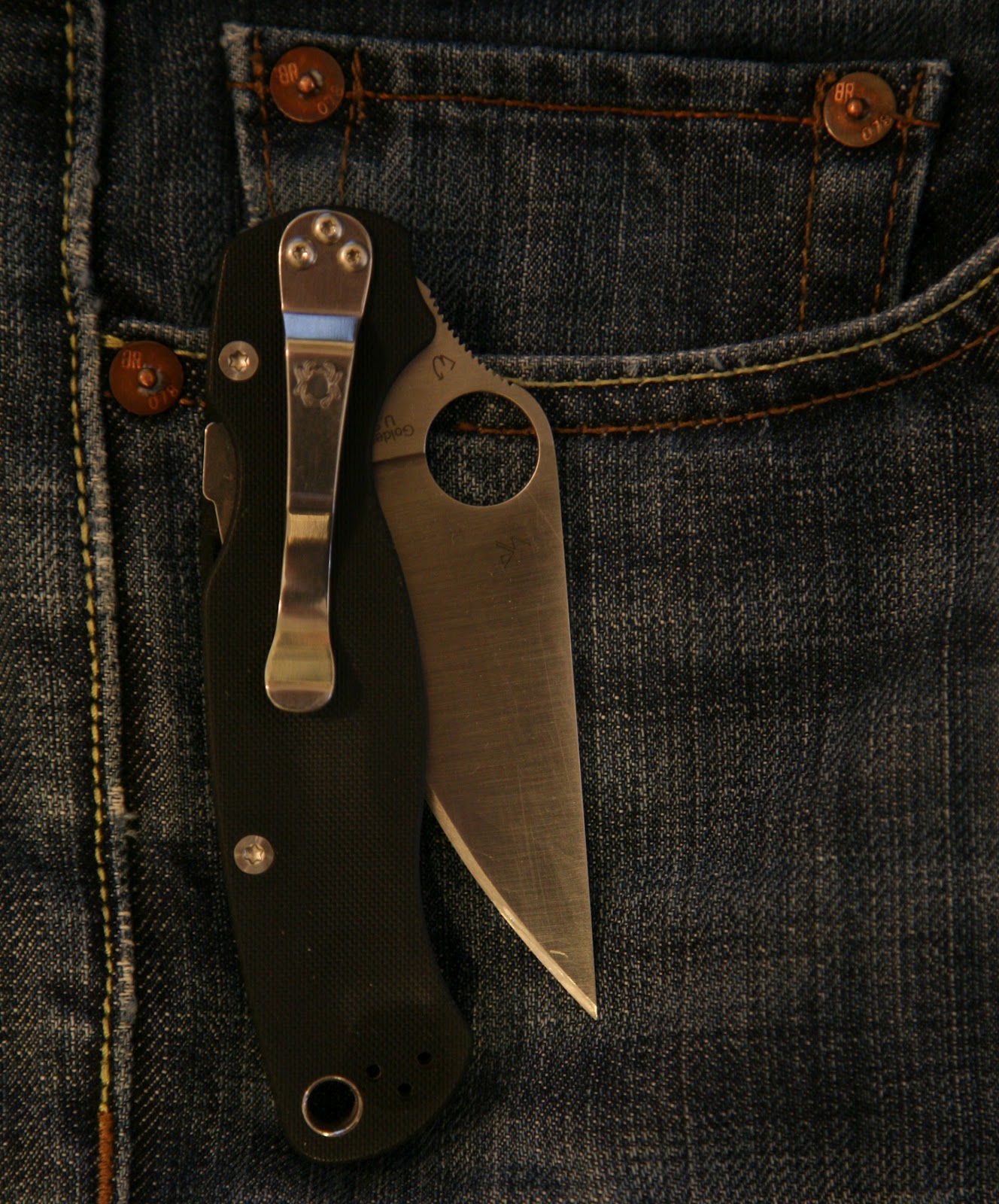
Blade deployment is a problem in tip-down forward carry. As seen, the blade may open unhindered and can pose a hazard.

Tip-down rearward carry. A decent solution, but deployment after retrieval is complicated by the opening hardware (here a thumb-hole) facing in the wrong direction.

It's unlikely that the blade would open, as depicted, as the rear seam of the pocket acts as a barrier.

Tip-up rearward carry. By far, the best option. Deployment following retrieval is uninhibited and the potential for the blade to unintentionally open in the pocket is minimized.

As with all blade-rear carry, the potential for unintentional opening is nearly zero; the rear seam of the pocket effectively mitigates the risk.
Carry tip-up blade-rear. You don't have a good reason to do otherwise.
5/8/12
< 101 - It's "Everyday Carry," not "Everyday Use"
The phrase “everyday carry” is simple, referring to the the carrying of various objects on one’s person everyday.
However, some critics seem to think that things shouldn’t be carried unless they’re actually used everyday. They suggest that if it’s not always useful it shouldn’t take up pocket space.
It’s an interesting idea but, ultimately, lacking merit.
Everyone carries a bunch of things that they won’t necessarily use on any given day. They carry things that they might need.
Go ahead, empty your pockets. I’ll wait. I guarantee at least half of what you carried around today you didn’t actually use...
4/25/12
Optimization
One of the most frequently overlooked things in the EDC movement is where people put all the stuff they're carrying. Descriptions of what’s in people’s pockets accompanied by photographs of neatly organized stuff fail to answer one of the most intriguing questions: how do people actually put all that stuff in their pockets?
It's not enough to simply have things; you have to carry them, too. This means considering three very important things: (1) comfort; (2) accessibility; and, (3) durability. I like to think of this as "optimization."
Comfort
I think most people consider comfort first. They arrange things in their pockets in a manner that doesn't unnecessarily inhibit movement or create irritating bulges or pokes.
This is a good place to start as if something isn't comfortable it probably won't be carried. Most people won't and shouldn’t choose to be uncomfortable.
I'm constantly rearranging things in my pockets in an attempt to find the most comfortable way to carry things. While I always try to maintain roughly the same placement of gear (flashlight and knife on my right, notebook and pen on my left, and so forth), I am willing to shuffle stuff around a bit if I can find better ways to carry it.
Of course, some things are more comfortable to carry than other things. Choosing the right gear is essential when it comes to comfort. This is, as always, a balancing game: maximize your utility without unnecessarily inconveniencing yourself. That two-cell flashlight might be nice, but a single-cell might fulfill the same role; that extra inch of blade might not be all that useful; maybe you can ditch those kitschy keychain accessories...
Accessibility
Utility is directly proportional to accessibility. The most useful item in the world would immediately lose its utility if it couldn’t be accessed. Along the same lines, if something is difficult to retrieve it won’t be used frequently, even in opportunities which might benefit from its use. Sure, it might be nice to grab that flashlight to look for your dropped keys in the dark but if it's stuffed in your backpack you might just bend over and grope around for a minute.
Of course, things that might be needed in an emergency should be easily accessible, too. One of the worst feelings is needing something, knowing where it is, but not being able to get to it.
In my pockets, for example, the three most easily accessible things are my primary pen, my folding knife, and my flashlight. Of the three, I use my pen most frequently. My knife and flashlight aren't as used as often, but there's quickly accessible in case the need suddenly arises.
As such, there's a certain discipline in deciding where to put things. For me, the most frequently-used things are the most accessible followed by items that may be suddenly and unexpectedly needed.
Legal concerns should also be mentioned with regard to accessibility. While most EDC items aren't strictly regulated in most jurisdictions, there are some that do concern themselves with what's in your pockets. Those that carry firearms have the most to worry about when it comes to conforming to the law; many states that allow concealed carry have strict "brandishing" laws which can be broken by a handgun shaped bulge, a poorly tucked shirt, or by retrieving an item from overhead. Some jurisdictions have the same laws with regard to knives. In some places (New York City comes to mind) you must carry your knives concealed; they have roughly the same brandishing laws that other places do for firearms. While it may be easier to access your equipment if it's more "open carried" than not, that access may be putting you in violation of local law.
Durability
There's the durability of individual pieces of equipment and then there's the durability of that equipment when it interacts with other stuff in your pocket.
For example, the Moleskine notebook I had been carrying is a relatively durable product on its own. It’s survived months of daily carry and use. The trouble comes when it sits in a pocket with something that’s “more durable.” When the Moleskine stays in a pocket with a cell phone, for example, it can quickly be damaged. Or if that same cell phone were to sit in a pocket next to a folding knife it would likely suffer quite a bit.
So, the placement of things in pockets should be considered in relation to the other things in those same pockets.
Moreover, there are certain components of various products that are more prone to damage. For example, the lens on a flashlight it far easier to damage than its machined aluminum body. That lens usually sits closest to the bottom of the pocket, too. As such, carrying keys or loose change in the same pocket has the potential to cause premature damage to that flashlight.
Ultimately
There are certainly other things to consider when deciding where to carry things. Aesthetics and clothing choice quickly come to mind. Comfort, accessibility, and durability shouldn't be overlooked, though. They're a great place to start and can do wonders in guiding further experimentation.
After all, what's the point in carrying stuff if you aren't going to carry it well?
4/18/12
On Prefab EDC Kits
With the growing popularity of everyday carry retailers are jumping on the bandwagon and doing all they can to get a piece of the action. Generally, I think this is great; the more the merrier. However, there are a few developments that I find mildly troubling. One of those developments is the emergence of prefabricated “EDC kits.”
There’s one that comes to mind. It’s being offered here for $44. It consists of a split-pea lighter, a set of tweezers, a pry-bar, and two just-slightly-larger-than-a-key screwdrivers (one phillips and one flathead). All the items are sourced from CountyComm, as far as I can tell.
As an initial observation, I find it a bit silly that they explicitly state in the description that EDC is personally defined and that it’s the result of evaluating and satisfying personal needs while they’re selling a package of stuff that is neither for the vast majority of people.
While the kit consists of relatively high-quality gear it’s also a compilation of stuff that most people probably don’t need. Of course, it’s retail; they’re trying to capitalize on an emerging market and offer a product that people will actually buy. However, as the EDC movement receives growing attention and popularity there will be more and more people trying to find their way into carrying “stuff.” That means that there are plenty of people out there who will try to jump on the EDC bandwagon by purchasing things like the prefabricated kit, throw the stuff in their pocket, and occasionally take pictures of it to post on the internet.
That’s not really EDC, is it? If everyday carry is truly the careful evaluation of one’s own needs and the carrying of gear to satisfy those needs then buying a kit of stuff that has been thrown together by someone else - a kit of things that are more superfluous accessories than anything - is offensive to the underlying principles of EDC.
Sure, if you’ve decided that you’re in desperate need of a less-than-accessible lighter, a pair of tweezers, a tiny pry bar, and some screwdrivers on your keychain this solution is for you. Absent that unlikely scenario, this compilation is a tad silly.
I can only imagine that people who purchase this “EDC kit” - or any other, for that matter - either quickly retire the majority of pieces to a drawer or keep their keychain and pockets unnecessarily cluttered with stuff that they’ll never use...
4/3/12
Keychain Minimalism
I wrote a < 101 a little while back about keychains and I wanted to expand on how I arrived at my current configuration.
I used to have a much busier keychain. It consisted of at least two split-rings with a “remove before flight” tag, some random souvenir my father had brought back from Vietnam (I’m still not sure what it actually is), keys to doors I hadn’t seen in years, a key for the faceplate lock on my desktop computer that I hadn’t started in nearly half a decade, useless Red Bull tabs, an armadillo bottle opener, and other random things. It was heavy, oddly shaped, and didn't sit right in a pocket. In short, it was a pain.
When I finally decided to do something about the mounting clutter I chose to take a much more streamlined approach. I really only have five keys I need, four of which I use on a daily basis (car key, apartment complex key, apartment key, mailbox key) and one I use infrequently but seemed relevant enough to keep around.
I removed everything I didn’t actually use. That meant getting rid of the giant red tag, the random thing from Vietnam, the various keys I hadn’t touched in forever, and all the other superfluous stuff.
I added a CRKT P.E.C.K. for two reasons: first, I thought having a small, keychain-sized knife would be handy; and second (perhaps more importantly) it took up the rest of the space available on the chain shackle itself; this prevented the rest of the keys from jingling about. In order to add the P.E.C.K. I had to remove the pocket clip and then add a small washer to retain the proper spacing on the pivot-screw. This was simple enough as the pocket clip was just attached with torx screws. Another benefit to this mod was finding a reason to purchase a small torx screwdriver.
I chose to put everything on a chain shackle in an effort to keep things in their place (chain shackles are available in most hardware stores or, as linked, online). I had seen other solutions similar to this one; one using half of an old Leatherman Micra; a more commercial option; and a couple variations of those themes. A few of the holes on the heads of the keys required some enlargement to fit onto the chain shackle, I accomplished this with a couple seconds of filing.
At first, the bolt of the chain shackle when tightened down completely inhibited easy rotation of the keys. When I loosened the bolt to allow rotation it would continue loosening in my pocket. I rectified this by tightening the bolt as desired and fastening the end of the bolt with a bit of super glue. It hasn’t moved since.
This keychain solution has allowed me to keep all my keys aligned and close together. The keys are easy to access individually and the chain shackle gives a far better grip when actually turning a key. They don’t bunch in a pocket or jingle excessively when being used. The PECK has come in handy more than a couple times. I've also discovered that the keys and chain shackle setup essentially creates a longer handle; I can pinch the pivot screw between my thumb and index finger and have the keys folded away from the knife creating a usable handle that fits the length of my palm.
I’ve been running my chain-shackle setup for quite some time now and haven’t found anything to complain about. Slimming down my keys has been one of the easiest and most beneficial things I’ve done with respect to my EDC kit.

3/9/12
< 101 - Keychains
Some people put way too much stuff on their keychains.
I’m sure everyone knows someone who collects superfluous things on a split-ring that they miraculously squeeze into their pocket; someone who could lose their keys amidst all their dangling accessories.
I was once afflicted, too. I had useless trinkets, a massive aluminum armadillo bottle-opener, and keys to doors I hadn’t seen in years dangling from a split-ring.
Carrying that much stuff is unnecessary. It takes up valuable space, hinders efficient use of the things you do need, and usually looks a bit silly.
When it comes to keychains, minimalism works.

3/7/12
From the Foundation and Forward
It’s the classic example: you’re just getting into this whole “everyday carry” thing and you’re excited about building a mountain of stuff to put in your pockets. You’re looking to start buying a couple pieces of gear to add to the basics you already have. Most people seem to start with a knife and a flashlight. Those are great things to consider carrying right off the bat. Of course, as with most people, you don’t have a mountain of money to buy your mountain of stuff.
Looking at the available options you’re probably a bit overwhelmed, I know I was (still am - there’s so much stuff to know). There are so many things out there to choose from. As you’re just starting to consider buying these sorts of tools you’re not too familiar with them; are those pricey items really worth it when there are plenty of far less expensive options?
The temptation to buy an inexpensive flashlight and an inexpensive knife is persistent. If you do you can have both right now and then arrange your purchases into a neat little pile, take a photo, post it to the internet, then bask in the glory that’s in your pockets.
Not so fast
Quality gear is an investment. Spend the money on something bomb-proof and it’ll treat you well. Buy cheaper gear and you’ll likely be looking for a replacement sooner than later, most likely after you’ve experienced a gear failure at an inopportune time.
If you’re on a relatively tight budget and can’t afford to buy quality gear all at once, it’s better to construct your carry piece by quality piece.
Evaluate your needs, determine which items are more important, and devise a strategy of purchasing which emphasizes picking up quality pieces over a longer time. In the end, you’ll have far better gear that will serve you far longer and, ultimately, you’ll be more satisfied.
Obviously, buying pieces that aren’t within any fathomable budget isn’t necessary. You don’t have to break the bank; there is a middle-ground between high-end and crap and it’s populated with awesome things. There are great pieces available from reputable companies for reasonable prices.
Of course, this “higher-quality is better” argument should be qualified; you probably shouldn’t be buying an incredibly high-end product if you haven’t established a strong need for it. For example, spending $500 on a Strider for your first knife isn’t necessarily the best decision. There’s a period in the very beginning of developing an EDC discipline where you discover what you really need. It wouldn’t be a wise investment to buy a high-end custom knife just to discover months from purchase that you haven’t opened it once.
Don’t jump in head-first
You’ve convinced yourself that buying higher-quality gear is the right idea, where do you go from there? To the internet, of course!
There’s a wealth of information available online about practically everything. There are plenty of third-party reviews and discussions about various products and product features. You should know what you’re buying before you buy it; not just what it looks like and the various specifications, but how those things affect its functionality and how it measures up to other products. If you’re not sure about something there’s bound to be a forum with someone who has an answer, you just need to ask.
Have fun
The most important thing to remember is that half the fun of buying new gear is the process of finding something that you truly love. The more time you spend deciding which gear to purchase likely correlates to the longer time you’ll spend enjoying your purchase rather than lamenting a hasty decision.
Not to mention, in the process of researching technical details, reading reviews, and browsing through pages of products you’re learning quite a bit. Learning is still fun, right?
An investment of time and consideration into your gear guarantees a far better return on any financial investment.
Useful links
A couple places to get started:
Layman’s Flashlight Reviews
Light Reviews
Blade Reviews
The Edge Observer
Candlepower Forums
Blade Forums
3/4/12
< 101 - Contemplation
EDC is as much about contemplation as it is about carrying stuff.
It's about observation, choices, and refinement.
One can get lost trying to stuff their pockets based on the banter of internet kibitzers and armchair commandos. But, ultimately, EDC is about discovering what you need to carry, not what someone else thinks you should carry.
Certainly, there are arguments to be made regarding the utility and practicality of certain things (a gentleman should always carry a knife) but, ultimately, EDC is a discipline comprised of personal choice and individual need.
After all, they're your pockets.
Subscribe to:
Posts (Atom)